Federal officials want California to hold ballots for citizenship checks. UCLA researchers question the accuracy of the government’s list, raising concerns about eligible voters just before Election Day.
A California voter could have registered legally, received a mail ballot and returned it, only to find that federal officials want that ballot held for another citizenship check.
That is the concern at the center of an election dispute now before the U.S. Supreme Court.
On November 2, the Trump administration asked the justices to intervene after lower courts rejected its request to separate ballots associated with more than 20,000 people whose citizenship federal investigators have questioned.
But a new analysis by UCLA’s Voting Rights Project raises doubts about the list used to identify those people.
Researchers examined 20,930 names supplied by the Justice Department and reported that 8,880, or about 42%, could not be matched to California’s voter file. They also identified at least 22 apparent U.S. citizens among those flagged.
The Justice Department disputes the findings and says its investigation is intended to prevent unlawful voting.
The central question is whether the government has enough reliable evidence to justify holding ballots that may belong to eligible voters.
What UCLA found in the federal voter list
The dispute began with a federal investigation comparing California voter-registration information with immigration-related records.
On October 15, the Justice Department announced a lawsuit against California, alleging that more than 20,000 likely noncitizens appeared on the state’s voter rolls.
Federal officials wanted election administrators to identify ballots associated with those names and keep them separate until citizenship could be verified.
Researchers working with UCLA’s Voting Rights Project and the Coalition for Humane Immigrant Rights, or CHIRLA, challenged the reliability of the list.
Their analysis found that 8,880 names could not be matched to California’s current voter records.
That doesn’t necessarily mean those people are citizens or that federal investigators identified the wrong individuals. It means the researchers could not establish corresponding voter records using the information available to them.
They also identified at least 22 apparent citizens and estimated that nearly 7,500 naturalized citizens could be wrongly flagged under the government’s matching approach.
The larger number is an estimate, not 7,500 individually verified cases.
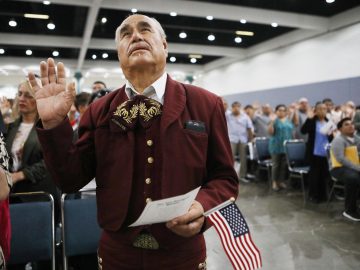
This is important for people who became U.S. citizens after arriving in this country.
Someone who once held a green card may later become a citizen. If an older government record doesn’t reflect that change, it could create questions about someone who is legally eligible to vote.
As Parriva recently reported on Mexican-born Americans and California’s electorate, naturalized citizens accounted for approximately 22% of California’s eligible voters in 2024, according to Pew Research Center.
The UCLA findings have not been independently reproduced by Parriva, and the federal government disputes their conclusions.
Why the Justice Department wants ballots separated
The Justice Department argues that only eligible citizens should vote and that ballots associated with potentially ineligible voters should be held until their status is verified.
Its concern is that once mail ballots are removed from their identifying envelopes and mixed with other ballots, election officials cannot retrieve an individual vote for further review.
California officials oppose the request, arguing that the list is unreliable and that a new verification process during an election could prevent eligible citizens from having their votes counted.
Los Angeles County conducted its own review.
Of the 20,930 records, 7,035 had county addresses. In a sample of 200 of those records, county officials found that 112 involved canceled or inactive registrations. More than 71% had no voting history.
Those findings do not resolve the citizenship status of everyone on the federal list. They do show why being flagged in a database is different from proving that someone cast an unlawful ballot.
On October 28, a federal district judge rejected the government’s emergency request. The Ninth Circuit Court of Appeals declined to grant the requested relief on October 30.
The appellate court pointed to unresolved questions about the list’s reliability, including the absence of disclosed error rates and validation against a dependable benchmark.
The government maintains that delaying verification risks allowing ineligible ballots to be counted. California argues that separating ballots on an uncertain basis risks excluding lawful votes.
On November 2, the administration asked the Supreme Court to intervene.
That request is not itself an order requiring California to hold the ballots. The lower courts had rejected the emergency measure.
What California voters need to know
For a naturalized citizen, the possibility of being incorrectly identified as a noncitizen is more than a paperwork problem.
It can raise questions about a right acquired through citizenship.
Parriva has previously explained how federal voter investigations can affect naturalized citizens. Those investigations are separate from the current ballot-segregation dispute, but both involve concerns about government records and citizenship verification.
The UCLA analysis does not establish that thousands of citizens have already lost their votes. Nor has a court determined that the Justice Department’s list accurately identifies thousands of ineligible voters.
For eligible Californians, the immediate steps are practical.
You can check your voter-registration information through the California Secretary of State.
If you’ve returned a mail ballot, the state’s Where’s My Ballot service provides ballot-status notifications.
If an election official questions your registration or eligibility, ask for an explanation and contact your county elections office. Depending on the circumstances, additional voting procedures may be available.
Parriva also has a guide for Los Angeles County voters who encounter registration problems, including steps to document what happened and request assistance.
The dispute now before the Supreme Court concerns how far federal officials can go when asking election administrators to act on contested citizenship records.
For California’s millions of eligible voters, the question is whether those records are reliable enough to justify delaying a ballot’s inclusion in the count.
With Election Day approaching, the answer matters both to election officials responsible for enforcing the rules and to citizens expecting their lawful votes to be counted.