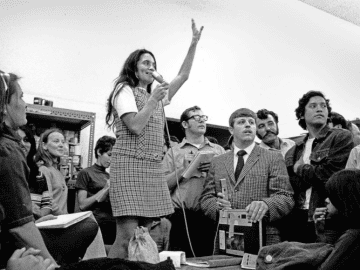
The filmmaker behind Selena and El Norte shares the decades-long friendship, family ties and personal promise behind his planned Dolores Huerta biopic.
For filmmaker Gregory Nava, telling the story of the civil rights icon is more than a Hollywood project. It is a deeply personal commitment rooted in decades of friendship, family and trust.
Before Gregory Nava set out to bring Dolores Huerta’s life to the big screen, he knew her as a friend.
The award-winning filmmaker behind Selena and El Norte shared a relationship with the legendary labor organizer that extended far beyond the world of cinema. Over decades, Huerta became part of Nava’s personal life, connecting him with the woman who would become his wife, welcoming him into her family circle and eventually entrusting him with the story of her extraordinary life.
Now, following Huerta’s death at the age of 96, Nava faces the task of preserving the legacy of a woman whose influence helped shape the American labor movement. But for him, the responsibility carries a weight that cannot be measured in box office numbers or critical acclaim. He is preparing to tell the story of someone he knew, admired, and loved as a friend.
Their connection began long before the biographical film became a shared ambition. Huerta introduced Nava to Barbara Martinez Jitner, who later became his wife. She also served as a witness at their wedding, a detail that offers a glimpse into the closeness of their relationship. Huerta was not simply a prominent figure who crossed paths with the filmmaker. She was someone who helped shape his own family story.
That bond endured for decades. Nava and Martinez Jitner remained close to Huerta and her family, developing a friendship that eventually opened the door to one of the most personal projects of Nava’s career.
In 2024, the couple announced plans for a dramatic feature film about Huerta’s life. Nava would write and direct the project, while Martinez Jitner would serve as a co-writer and producer. The film would draw on Huerta’s own recollections, including more than 70 hours of conversations in which she shared experiences from her personal life and decades of activism.
The interviews offered an opportunity to explore the woman behind the public image. Huerta had spent much of her life fighting for farmworkers, advocating for civil rights and challenging the inequalities faced by Latino communities. Yet her life was also shaped by personal relationships, difficult choices, family responsibilities, and experiences that rarely make their way into the familiar accounts of historical figures.
For Nava and Martinez Jitner, listening to those stories was an act of friendship as much as an exercise in filmmaking. Huerta was trusting them with details of her life that she had not previously shared publicly. That confidence gave their project a significance beyond the usual relationship between a filmmaker and the subject of a biographical film.
Their friendship also included moments that had nothing to do with activism or Hollywood. Nava recalled taking Huerta to the opera and sharing experiences shaped by their appreciation of music and culture. Those memories reveal a more intimate side of their relationship, one grounded in companionship rather than public recognition.
When Huerta’s health declined rapidly in October 2026, Nava and his wife planned to visit her. He ultimately found himself beside her during her final hours, surrounded by members of her family.
Speaking to NBC Los Angeles after her death, Nava described the experience as an unbelievable, powerful, and moving moment. He recalled spending time with Huerta and her loved ones, saying goodbye to someone who had been part of his life for so long.
The moment brought the personal meaning of their relationship into sharp focus. Nava was not simply a filmmaker witnessing the passing of a historical figure whose story he hoped to tell. He was a longtime friend saying goodbye to a woman who had helped bring his own family together.
Huerta’s death also left the couple with a promise to fulfill. Nava has said he intends to continue working on the film, carrying forward the story she entrusted to them. According to his recollections, Huerta wanted the project to do more than celebrate her own achievements. She hoped it would inspire a new generation to continue working for justice.
That wish now gives the film an added purpose. Huerta’s legacy belongs to the history of labor organizing and civil rights, but it also lives in the people who knew her personally and in the stories she chose to share with them.
For Nava, the challenge will be to bring both dimensions to the screen: the activist whose work transformed the lives of farmworkers and the friend whose warmth, trust, and presence left a lasting mark on his own life.