As the 2026 midterms approach, millions of young Americans who grew up with school lockdown drills and mass shooting fears could bring their concerns about gun violence and public safety to the ballot box.
For many young Americans, the possibility of a mass shooting is part of everyday life. They have practiced hiding in classrooms, received emergency alerts about shootings near their schools, and watched news of attacks unfold on their phones. Some have survived shootings themselves, only to encounter another before reaching their mid-twenties.
As California heads toward the November 2026 midterm elections, the experiences of these young voters are raising questions about whether gun violence, school safety and the fear of another shooting will help shape the election.
Nearly 50 million Americans ages 18 to 29 are eligible to vote in the midterms nationwide. About 60 percent say they plan to vote, according to figures cited by Tufts University’s Center for Information and Research on Civic Learning and Engagement. If young voters follow through at unusually high rates, they could help influence competitive races and increase the political attention paid to issues that matter to their generation.
Gun violence is one of those issues. For young people who have grown up amid repeated mass shootings, the debate over firearms is not simply an argument about laws or constitutional rights. It is also about whether they can feel safe at school, on a college campus, at a concert or in a crowded public space.
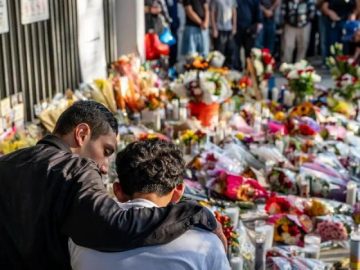
The numbers help explain why the issue remains difficult to ignore. The Gun Violence Archive recorded 408 mass shootings in the United States in 2025, down from 504 in 2024. The archive defines a mass shooting as an incident in which at least four people, excluding the shooter, are shot. Those incidents in 2025 caused 395 deaths and 1,867 injuries, according to an analysis The Trace published in January 2026.
Although the annual total declined, hundreds of incidents still occurred in a single year. For a generation that has spent much of its childhood and adolescence watching mass shootings become recurring national news, the decline does not necessarily erase the fear.
The experience of gun violence can also extend beyond those directly injured. Students may worry about their safety even when an attack occurs in another state. Emergency drills, news alerts and images circulating on social media can reinforce the possibility that a familiar place could become the scene of a shooting.
For survivors, that fear can be more immediate. In April 2025, a shooting at Florida State University brought renewed attention to the experiences of students who had already lived through the 2018 shooting at Marjory Stoneman Douglas High School in Parkland, Florida. The possibility of encountering another shooting can complicate the process of returning to classrooms and rebuilding a sense of security.
Researchers have described young Americans who grew up in the aftermath of the Columbine High School shooting as a generation shaped by mass violence. School security measures and lockdown drills have become familiar parts of their education, even for students who have never experienced an attack firsthand.
California offers an important setting to examine how these experiences intersect with politics. The state has enacted several gun safety measures and has been a center of national debates over firearm restrictions. In the midterms, voters will also be weighing the economy, housing costs, immigration, education, and the performance of elected officials.
That makes the political significance of young voters an open question rather than a foregone conclusion. Strong interest in an issue does not automatically translate into turnout, and concern about gun violence does not mean all young voters support the same policies. Some prioritize stricter firearm regulations, while others emphasize school security, enforcement of existing laws or protection of gun ownership rights.
Still, if younger voters participate at higher rates, their priorities could influence how candidates discuss public safety and which issues receive attention during the campaign. In closely contested races, turnout among younger voters could matter, although the effect will depend on where they live, which candidates they support, and what motivates them to vote.
For candidates, understanding these voters requires more than citing statistics about shootings. It means understanding how repeated exposure to gun violence affects young people’s expectations of safety and what they want public officials to do about it.
Interviews with students, young survivors, and first-time voters could help reveal whether fear of shootings is changing their political priorities, or whether other concerns take precedence when they enter the voting booth.
For many young Americans, the central question is not whether they have heard about another mass shooting. It is whether they have grown accustomed to the possibility of one.
As California’s election campaign unfolds, their experiences could offer a window into how a generation raised on lockdown drills and breaking news understands public safety, government responsibility and its own political power. Whether those concerns translate into votes remains to be seen. But the stakes are personal for young people who want to attend school, gather with friends and plan their futures without constantly wondering where the next shooting might happen.