@ Yvonne Venegas
Through Shakespeare’s Cordelia and her role in Juana, Diana Sedano confronts injustice, violence, loss, and the healing power of telling the truth.
She is sitting on a small bench onstage. It is strange to see her there, while the audience is looking for their seats in the theater; the lights are dim, and the murmur of the crowd becomes part of an unplanned choreography. It is Diana Sedano, one of the lead actresses in the play that is about to be performed. Sitting sideways, she watches. She does not speak. You cannot perceive a gesture, a message, a revelation. Is she living alongside the ghosts who have walked across that stage? We do not know. We simply watch her for a few moments, and then accompany her as she slowly walks away. She appears, disappears, but not her stories.
That night, another performance of King Lear is about to begin, a remarkable production of Shakespeare’s masterpiece that has shaken Mexico City. In it, Diana plays Cordelia, the youngest daughter of King Lear, an honest, principled, and loyal woman who refuses to flatter her father to gain power. She represents truth and genuine love in contrast to the ambition and deceit of her sisters. And that is one of the qualities that connects her to Juana, the lead role she plays in the film of the same name, which has been widely recognized in Mexico and abroad and earned her a nomination for Mexico’s highest film awards, the Ariel Awards, where she is among the nominees for Best Actress.
“Shakespeare is fucking incredible,” she says in a phone interview, opening the conversation about the themes of Lear. “In his work, he touches on all the universal problems of this world, as Maestro Luis (de Tavira) says. There, we recreate the deepest sensitivity of the human being, of the world, regardless of the era. I find it interesting what you journalists say,” she says. “That parallel between Cordelia and Juana is interesting. Juana reminds us that the fight against injustice is fundamental, that complicit silence is terrible, that silence kills.”
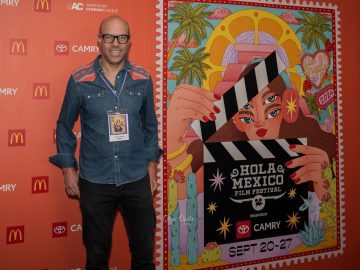
Juana will be presented at the Hola México Film Festival on September 26 and 27 in Los Angeles.
Daniel Giménez Cacho’s feature directorial debut has the urgency of an investigative thriller, but its most important investigation turns inward. Led by Diana Sedano’s visceral and unpredictable performance, Juana follows a woman discovering what silence has cost her and whether facing the truth can become a way back to herself.
At 45, Juana has spent more than a decade surviving through silence. Her days have narrowed to an unfulfilling job at the Siglo XXI newspaper, visits with her mother in a nursing home, and the daily effort of keeping her panic attacks under control. Then an assignment brings back a name she thought she had buried: Pedro Núñez, a corrupt politician connected to a criminal network and to the murders of her boyfriend and a fellow journalist.
Returning to the investigation means confronting far more than a powerful man. It forces Juana into the memories, wounds, and compromises that have shaped her life, according to festival organizers.
@talipotstudio
When Truth Becomes a Form of Resistance
Diana will not be able to attend the presentation in Los Angeles, despite how much she wants to. She still has theater performances, and she can’t make it. “I really wanted to see how the film would be received. In Estonia and Spain, they have embraced it; it has made a strong impact. I am left wanting more, especially in Los Angeles, where I have something important pending.”
Juana’s journey in the film is a journey of healing in the “crazy” world we live in, where violence against women is becoming increasingly alarming, and solutions are becoming increasingly scarce.
“As they told me in school, the characters choose us. This conflict has been wonderful. For me, it has been a journey of healing. These two characters, Cordelia and Juana, came into my life at a very important moment, when I had suffered countless losses. My mother died recently, and my father at the beginning of this year. Life had been hitting me hard. With the death of my parents came the full weight of what their loss represents. You understand the loss of a mother in a completely different way. Many times, I have asked myself, ‘Why is this happening to me?’ And then I live Juana. I go inside her, she gets inside me, and then there is Cordelia,” the actress says.
The film directed by the renowned Daniel Giménez Cacho was one of her blessings.
“It was wonderful working with Daniel, the director. He is very systematic. Many times I had a struggle with a scene, and he always grounded me. In the bathroom scene, where I bathe my mother in the story, a very powerful scene, I was very immersed in it. In the final scene, when I had to let go of everything that Juana had, and Diana had, that scream that came out and liberated me in those moments, Daniel always told me to see it as a healing process. That is what it was,” she adds.
Diana’s voice is firm, clear, and direct. She does not beat around the bush. She is conscious of what her characters are and the way she takes them on. Words such as power, violence, love, justice, injustice, shame, shamelessness and many others float through the conversation. She distances herself from the stories, looks at them as an observer, and then steps inside them, lives them, and defends them.
“In Lear, violence has to do with power. For me, that is the real problem. You cannot strip someone of who they are and what they have. That is the fucking thing, violence as the conduit of power, and we are living through moments of tremendous power,” she says, and I am reminded of the lines Cordelia says to Lear when he demands that she tell him how much she loves him. She expresses that there are no words that can describe that love and that feeling.
Diana researched the world of journalism and the violence that many people experience every day at the hands of crime. The way female journalists expose themselves.
“They are incredible women. They left me deeply impacted. Daniel Giménez Cacho himself told me that he could not understand why they did it. These journalists cannot stop doing it, they have to keep investigating. We artists, have to take this on with that respect and commitment. I started investigating things that are not pleasant, confronting things that people do not want to see,” she says.
@ReyLear
Violence
Diana remembers what a theater director used to say about what theater and artists contribute to social issues.
“She always told us that life is running, running, and it cannot be stopped. Especially in the world today, where things happen so quickly. There is so much information. And she would say that the work of artists has the ability to stop it. I have the feeling that we have already reached the point where we see violence as something normal. There was a change when the Me Too movement emerged, but afterward we went back to it. We became accustomed to these images of violence. We see them, we point them out, and then we continue with our lives. That is the contribution I believe Lear and Juana make. They are representations that bring us back, again and again, to the problem we are living through, and perhaps these works come once again to remind us of it,” she says.
Diana acknowledges that portraying Juana transformed her, filled her with a new kind of courage. She recognizes that it makes her angry that so many women continue to suffer injustice, mistreatment, the pain of losing their children, like the ‘Madres buscadoras’, and domestic violence.
“I have a lot of anger. It is difficult for me, but this whole process I have gone through has also led me to concentrate and focus my efforts on things that have given me other perspectives. As I mentioned, things happen so quickly that sometimes they do not allow us to properly reconsider the different situations. Now I try to do things with more patience, without rushing. I take my time. I try not to respond impulsively. I think that is part of the learning and the healing process. We have to work in favor of things. You take on a job that takes you into different realities, you take on different roles, you fight with them, you embrace them and try to deal with a reality that many people continue to live through at different stages,” she reflects.
@IvonneSalgado
A Journey of Healing
Just like her recent heroines, Diana continues along her own path, that of the woman who always dreamed of becoming an actress and believed that once she achieved it, she would have reached a destination. This evolution has placed her somewhere else. She has become convinced that the journey of searching continues, that becoming and having managed to become an actress in every sense of the word is and will continue to be important.
“I have realized that my commitment goes beyond acting. I thought that was it, but now I have several worlds left to discover, several things to understand. This Ariel nomination is a satisfaction. It feels good; I am not going to deny it. Seeing your name alongside actresses with whom you have grown throughout your career and whom you admire is something very beautiful. You realize that your work is valued. There are many things that continue to turn over in my head. There are other stories to tell. Now I am preparing to do something I love, teaching. It is something I really enjoy. I will also be part of another theater production, Anatomy of a Suicide. And I will tell you, being an actress is fucking hard,” she says.
“Are you a llorona (crier)?” I ask her.
“And now even more so. I cry over anything. I am very emotional. I am going to enjoy the Ariel Awards, but it also makes me sad that my mother will not be able to see me, that I will not have her by my side. You have no idea how much I would have loved to see the look on her face,” she concludes.