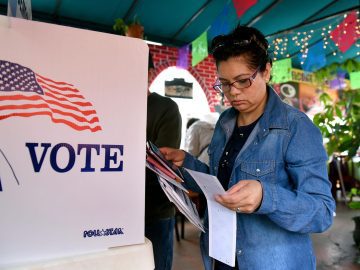
Nearly 288,000 Los Angeles County voters requested Spanish-language election materials during the June primary.
The figure is significant because it shows substantial demand for election information in Spanish. But it does not tell us how many of those voters are Latino, which candidate they support or how they will vote in November.
That distinction matters as Los Angeles prepares for the Nov. 3 mayoral runoff between Karen Bass and Nithya Raman. The Los Angeles City Clerk’s official election information confirms the November municipal election date.
What the 287,791 Number Actually Measures
Los Angeles County reported that 287,791 voters requested Spanish-language vote-by-mail materials for the June primary.
The county allows voters to request election materials in a preferred language. The system is designed around language access; not ethnicity.
That means the 287,791 figure should not be described as the number of Latino voters or Spanish-dominant voters.
A voter can identify as Latino and prefer English. A voter who is not Latino can request materials in Spanish. The language-request data alone does not distinguish between those groups.
The distinction is important because Parriva has previously examined Latino voter turnout and behavior in the Los Angeles mayoral race. That reporting looked at questions surrounding Latino participation and candidate support. The new county data measure something different: how voters choose to receive election information.
Language access is an important part of how election officials communicate with Los Angeles voters.
The city and county provide translated election materials and multilingual voter assistance. The Los Angeles City Clerk’s Spanish-language voter information explains the city’s Spanish-language election services.
The June primary also demonstrated that the mayoral candidates drew different levels of support across Los Angeles neighborhoods. Official Los Angeles County election results show Bass and Raman advanced to the November runoff.
Those results provide information about voting patterns.
The Spanish-language request data provide information about language preference.
They are related pieces of the electorate, but they are not the same measurement.
What June’s Results Show About Latino-Majority Neighborhoods
Primary results can provide a separate way to examine Latino political participation because analysts can compare candidate performance across neighborhoods with large Latino populations.
The Los Angeles Times found that Bass carried 35 Latino-majority neighborhoods in the June primary, compared with seven for Raman and one for Spencer Pratt. The analysis was based on precinct results and Census data; it did not identify how individual Latino voters voted.
Knowing that a candidate performed strongly in a Latino-majority neighborhood does not establish how Spanish-language voters voted there or how individual Latino voters will vote in November.
Both mayoral campaigns have sought support from Latino communities and used Spanish-language outreach as part of their broader campaign efforts. Reporting before the primary documented Spanish-language advertising, outreach in Latino-majority neighborhoods and efforts to build support among Latino voters.
That makes language an important part of the campaign environment. But campaign outreach is not evidence that a particular message has changed voter preferences or turnout.
Parriva’s earlier reporting on Latino voters in the Los Angeles mayoral race also examined the gap between political outreach and actual voter participation. The new language-access figure should be viewed separately from those questions.
The election will ultimately be determined by voters who participate in November.
What the Data Can’t Tell Us
The 287,791 requests cannot tell us:
- how many of those voters are Latino;
- how many live within the city of Los Angeles;
- how many will vote in November;
- which candidate they support;
- whether Spanish-language voters are more or less likely to vote than other voters; or
- whether Latino voters will determine the outcome of the mayoral runoff.
It also cannot establish that Spanish-language outreach by either campaign will produce additional votes.
Nearly 288,000 Spanish-language election-material requests provide a concrete measure of demand for election information in Spanish.
That is useful information as Los Angeles campaigns communicate with voters.
But language preference is not a substitute for ethnicity, and neither language-access data nor Latino population size can tell us how voters will behave in November.
The most reliable conclusion is therefore also the simplest:
Los Angeles has a large and measurable demand for Spanish-language election information. What those voters ultimately do with that information remains an open question.