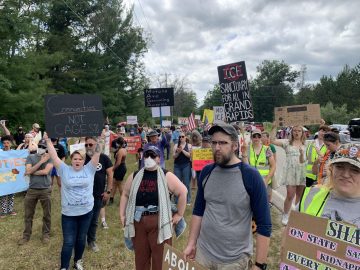
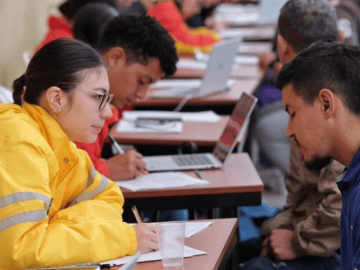
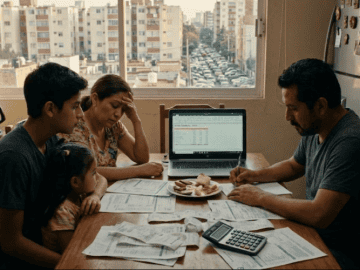
You do not have to be detained by immigration agents to be harmed by immigration enforcement. Across the country, fear of ICE is keeping people away from hospitals, classrooms and police. Doctors are seeing sicker patients. Schools are seeing students disappear from classrooms. And police data show that calls for service can fall when immigration enforcement intensifies.
The debate over ICE tactics tends to focus on individual encounters: an arrest, a shooting, a death in custody. But a growing body of clinical, public health and law enforcement research describes something broader and harder to see: people changing their behavior out of fear, whether or not they ever encounter an immigration agent.
The costs are showing up in emergency rooms, school attendance records and police call logs.
A stillbirth that did not have to happen
Daniel Payne of STAT News reported the case of a pregnant patient brought to Dr. David Hill in North Carolina after a stillbirth that Hill said was likely preventable. It was the first time the patient had seen a doctor during her entire pregnancy.
Fear of immigration enforcement, doctors nationwide say, is driving patients to delay or skip care.
At St. John’s Community Health in Los Angeles, no show rates for medical appointments more than tripled during intense immigration raids last summer, with nearly one in three scheduled patients failing to show.
In Minneapolis, some parents are now sending children to the emergency room with neighbors instead of taking them themselves, staying on the phone because they are too afraid to leave the house, according to reporting on Children’s Minnesota.
The hospital’s emergency department typically sees around 130 patients a day. That number has dropped to roughly 100, even during an unusually severe flu season, while admission rates have climbed nearly 5 percentage points, suggesting children are arriving sicker. One physician described treating a girl whose ear infection had progressed to a ruptured eardrum after her parents delayed bringing her in.
The fear extends past the people it is aimed at
Nearly 17,900 ICE detentions in fiscal year 2026 involved someone who self reported being a parent of a U.S. citizen child, according to the American Immigration Council, almost double the rate from fiscal year 2024.
When a parent is detained, families can face immediate income loss, housing instability and disrupted childcare and schooling. Employers lose workers. Schools lose students. Children lose friends and classmates.
The psychological toll on children in mixed status families has drawn particular concern from clinicians.
Dr. Melinda Macht Greenberg, a clinical psychologist at Tufts University, described the trauma of sudden parental detention:
“There’s the sadness, that’s a lot of the grief part. There’s the fear and the anxiety. Then there’s this tremendous difficulty in functioning.”
Pietra Adami, an organizer with the Brazilian Women’s Group, described the consequences as a public health issue:
“The behavioral health impacts we are seeing aren’t isolated incidents. They are predictable consequences of policies that separate families, create chronic fear, and make an entire community feel unsafe.”
In the Twin Cities, an 18 year old named Dulcie, who asked not to use her last name, described driving her parents to work as early as 4 a.m. before school because she is afraid they might disappear.
“I would rather do that than never hear from them,” she said.
She said all of her friends are staying home.
“No one comes out. It gets to me.”
Fear can keep people from calling 911
The chilling effect can reach the moment when someone needs help from police.
In Los Angeles, the Los Angeles Times analyzed LAPD emergency dispatch data from the summer of 2025, when federal immigration enforcement surged across the region. In the two weeks after June 6, calls for service to LAPD fell 28 percent compared with the same period a year earlier, an average of roughly 1,200 fewer calls per day. Domestic violence calls fell 7 percent, while family dispute calls fell 16 percent.
These were LAPD calls for service, not every 911 call, and the data cannot prove that every missing call represented an unreported crime.
But the findings fit earlier research. A peer reviewed study in the Journal of Urban Economics examined more than 3 million LAPD calls for service between 2014 and 2017. Researchers found that domestic violence calls fell in neighborhoods with larger Latino noncitizen populations as awareness of immigration enforcement increased.
Following the 2016 election, domestic violence calls in those neighborhoods fell about 8 percent relative to other areas.
A decline in calls does not mean there was less violence. It can mean fewer people were willing to ask for help.
Police can count the calls they receive. They cannot count the person who looks at the phone and decides that calling 911 is too risky.
Schools are seeing it too
The rescission in January 2025 of a longstanding “sensitive locations” policy, which had discouraged immigration enforcement at schools, hospitals and churches, has raised concerns among educators.
The National Academy of Education sent a formal letter to DHS and ICE in February 2026 urging a return to that guidance. Its president, Stanford professor Alfredo J. Artiles, wrote that educators are reporting “plummeting student attendance, decreased enrollments, emotional withdrawal, and fear and trauma associated with enforcement actions, regardless of the students’ immigration status.”
Separate analysis has projected that between 50,000 and more than 150,000 eligible U.S. citizen children could forgo Medicaid or CHIP enrollment because their parents fear that enrolling them could expose the family to immigration consequences.
The bottom line
None of this requires an ICE agent to knock on a particular family’s door.
Fear itself, spread through news coverage, social media, word of mouth and visible enforcement elsewhere, is changing behavior in ways doctors, teachers and researchers can measure.
Missed prenatal care.
Sicker children arriving later to emergency rooms.
Students disappearing from classrooms.
And fewer calls for police help.
The consequences of immigration enforcement therefore extend beyond the people ICE actually detains.
Sometimes the harm begins before an agent ever arrives.
Sometimes it begins when someone decides not to make the call.