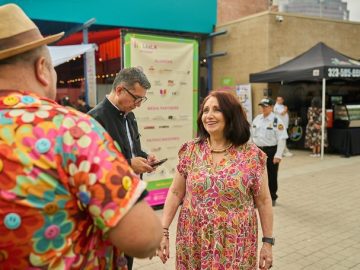
LéaLA returns to Los Angeles September 24–27, giving bilingual children and families a free space to discover Spanish-language books, authors, poetry and stories that connect generations.
In Los Angeles, Spanish is more than a language spoken by millions of residents. For generations of families, it has been the language of home, memory, culture and connection. For many young people growing up in the city, it is also part of an identity shaped by two languages and multiple cultural worlds.
That connection will be at the center of LéaLA – Spanish Language Book Fair & Literary Festival, which will officially launch its 2026 edition Thursday, August 20, with a press conference bringing together LéaLA leadership, representatives of the Los Angeles Unified School District (LAUSD), and the Consulate of Mexico in Los Angeles. The event will take place at the University of Guadalajara Foundation USA, 1111 S. Broadway, Suite 105, Los Angeles.
The kickoff will preview this year’s programming ahead of the four-day festival, which will take place September 24–27, 2026, at LA Plaza de Cultura y Artes in Los Angeles, during Hispanic Heritage Month.
Now in its 11th year, LéaLA is the largest Spanish-language book fair and literary festival in the United States. Organized by the University of Guadalajara Foundation USA, the festival’s 2026 edition will continue its mission of fostering dialogue through literature, critical thought, the exchange of ideas, film, poetry and children’s educational programming. All activities are free and open to the public.
Among those participating in the kickoff will be Marisol Schulz, director of LéaLA; Mtro. Gustavo Padilla, president of the University of Guadalajara Foundation USA; Ana M. Guzman, administrator of LAUSD’s Elementary Multilingual Multicultural Education Department; and Luis Ángel Castañeda Flores, consul for political affairs at the Consulate of Mexico in Los Angeles, representing the consul general.
This year’s theme, “The Stories That Unite Us Speak Spanish,” highlights the power of Spanish language and culture to connect communities, strengthen relationships and preserve shared heritage.
That message carries particular weight in Los Angeles, especially within its public schools.
A Spanish-speaking generation
The Los Angeles Unified School District (LAUSD) serves more than 500,000 students across Los Angeles and surrounding communities. Latino students make up roughly three-quarters of the district’s enrollment, making them by far the largest student demographic in LAUSD.
But Latino identity and Spanish-language use are not interchangeable. Many Latino students are bilingual or primarily English-speaking, while others may have limited or no Spanish proficiency.
At the same time, Spanish remains central to the district’s multilingual community. LAUSD students speak 98 different languages at home, and Spanish is the dominant primary language among the district’s English Learners.
The numbers, however, tell only part of the story.
Behind them are students who may hear Spanish from a parent or grandparent, speak it with relatives, read it at home or move naturally between Spanish and English depending on the setting.
For these students, Spanish can be much more than a second language.
It can be a connection to family history.
It can be a way to communicate across generations.
And it can be a pathway into literature, culture and ideas.
Why literature matters
For a child growing up between languages, seeing Spanish represented in books can send a powerful message: your language belongs here, too.
A Spanish-language book can allow a student to read in the language spoken by a grandparent. It can give parents and children an opportunity to share stories together. And for bilingual students, it can reinforce the idea that Spanish is not simply the language of informal conversations, it can also be a language of knowledge, creativity, critical thought and intellectual life.
That is one reason LéaLA’s mission extends beyond the traditional concept of a book fair.
The 2026 festival will feature literature, poetry, film, critical thought, the exchange of ideas and children’s educational programming. It is designed to bring readers, writers, educators and families together around the Spanish language.
In a city as linguistically diverse as Los Angeles, that creates a unique cultural space.
Connecting education and culture
The participation of LAUSD and the Consulate of Mexico in the festival’s kickoff also points to a broader conversation about the role of Spanish in the lives of Los Angeles students.
The question is not simply how many students speak Spanish. It is also what opportunities those students have to use, develop and celebrate the language.
For educators, multilingualism can be more than a challenge to address. It can be an asset students bring into the classroom and eventually into college, careers and civic life.
A student who speaks Spanish and English possesses the ability to navigate across languages, cultures and communities—an increasingly valuable skill in an interconnected world.
Literature can strengthen that ability.
A bridge between generations
Los Angeles is home to one of the largest and most culturally diverse Latino communities in the United States. For many families, the connection to Spanish is generational.
Parents may speak Spanish with their children. Grandparents may speak little English. Young people may respond in English even when they understand Spanish perfectly. Others move naturally between both languages.
A book can become a meeting point.
A child can discover a story that reflects a family experience. A parent can share a favorite author with a son or daughter. A bilingual teenager can discover that the language spoken at home is also a language of poetry, journalism, history and ideas.
That is why access to Spanish-language literature matters.
It is not about choosing Spanish over English. It is about giving students the opportunity to see both languages as part of their intellectual and cultural world.
More than a festival
LéaLA arrives at a moment when questions about language, identity and education remain deeply relevant in Los Angeles.
Its free programming provides families with access to authors, books, film, poetry and educational activities without the barrier of admission costs. It also creates a public space where Spanish is not translated away or treated as secondary—it is the language through which the festival’s central cultural conversation takes place.
For the city’s young Spanish-speaking and bilingual population, that representation matters.
The stories children encounter can help shape what they believe is possible for themselves. When they see their language, culture and experiences reflected in literature, they are not simply seeing themselves represented. They are also being invited into a larger conversation.
And that may be the most important idea behind LéaLA’s 2026 theme.
The stories that unite Los Angeles do not always begin in English. Many begin in Spanish.
For four days this September, those stories will have a place to be read, heard, discussed and shared.