

 Parriva's Team

As food insecurity affects up to half of college students, lawmakers push to clarify rules so eligible students don’t lose access to critical nutrition aid.
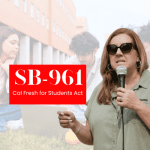
In the simplest terms, SB 961 — authored by California Senate Majority Leader Angelique Ashby — aims to make it easier for eligible college students to access CalFresh, California’s version of SNAP food assistance.
The bill does not expand benefits. Instead, it clarifies how student eligibility rules are applied in California, particularly the confusing federal “student rule” that often blocks or discourages qualified students from applying.
What SB 961 does:
-
Aligns state law more clearly with federal SNAP rules.
-
Reduces confusion around eligibility for college students enrolled at least half-time.
-
Helps campuses and counties better identify and support eligible students.
For many students, the problem isn’t eligibility — it’s access.
The Evidence: Hunger Is Undermining College Success
Research from the UCLA Center for Health Policy Research shows that up to 50% of California college students experience food insecurity. Yet according to a recent report covered by the Daily Bruin, 45% of food-insecure students had never used CalFresh — even though many qualified.
“Helping students stay in school and stay healthy … finances and being able to have food that keeps you healthy and focused,” researcher AJ Scheitler told the Daily Bruin, underscoring the link between nutrition and academic performance.
Other research cited by the California Policy Lab and campuses statewide shows that students receiving CalFresh are more likely to persist in school. At UC Santa Cruz, CalFresh participants posted a 94% first-year retention rate — higher than campus averages.
The financial impact is real. Eligible students can receive up to $292 per month — often covering about one-third of a community college student’s food budget in high-cost regions like Los Angeles.
And yet, participation drops sharply after high school. While roughly 19% of high school seniors receive SNAP benefits, many lose them once entering college — not because they’re ineligible, but because the system is confusing.
Why This Matters Now
The stakes are higher in today’s political climate. Federal benefit reductions, shifting SNAP rules, and administrative uncertainty have created instability for working-class families. At the same time, immigration enforcement activity has intensified anxiety in Latino communities, where mixed-status households may already fear engaging with public programs.
For Latino students — who are disproportionately first-generation and from lower-income households — access to nutrition support can mean the difference between staying enrolled or dropping out.
As Parriva previously reported, students juggling work, tuition, and family obligations often face impossible trade-offs between rent, books, and groceries. CalFresh reduces that pressure.
Support Cal. Senate Majority Leader Angelique Ashby by Signing This Petition
SB 961 is not a new spending program. It is a clarification bill — one designed to ensure students who already qualify for food assistance can actually access it.
In a state where half of college students report food insecurity, cutting through bureaucratic confusion is not just policy housekeeping. It is an education strategy.
When students don’t have to choose between textbooks and dinner, they are more likely to stay in school — and graduate.





Clínica Romero, Sen. Menjivar Advance SB 1179 to Expand Care Access in Underserved Communities
California Lawmakers Push Medi-Cal Access Restoration to Counter Coverage Freeze
IMMIGRATION
They Fled Domestic Abuse. ICE Detained Them Instead.
POLITICS
Nine Mexican Nationals Among 28 Charged in California Election Fraud Operation
For Young California Voters, Fear of Gun Violence Looms Over the Midterms
Can a Paycheck Still Buy a Life in Los Angeles? Inside the Mayoral Debate
In ‘Animals’, CHIRLA and the Latino Vote Are Won With a Lie. Could It Happen in L.A. Politics?