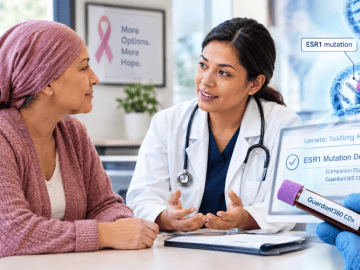
Merck and Moderna say their personalized mRNA therapy helped delay melanoma recurrence and distant spread. For Latino patients, the development comes against a troubling backdrop: melanoma is less common but often diagnosed later and associated with worse outcomes.
A new personalized cancer treatment has cleared a major hurdle in the fight against melanoma.
Merck and Moderna announced Aug. 19 that their Phase 3 INTerpath-001 trial found that intismeran autogene, an individualized mRNA-based therapy, combined with Merck’s Keytruda, significantly improved two important outcomes compared with Keytruda alone in people whose high-risk melanoma had been surgically removed.
The news is significant. But for Latino families, there is another question worth asking:
What could a development like this mean for patients who are less likely to develop melanoma in the first place — but more likely to be diagnosed at a later stage when they do?
What did the new melanoma trial find?
INTerpath-001 enrolled 1,137 people with completely resected stage IIB-IV cutaneous melanoma.
Patients were randomly assigned to receive either the personalized therapy plus Keytruda or Keytruda alone. The combination met its primary endpoint of recurrence-free survival (RFS) and a key secondary endpoint called distant metastasis-free survival (DMFS).
In plain English, patients receiving the combination went longer without the cancer returning and longer without the cancer spreading to distant parts of the body.
The companies described the improvements as both statistically significant and clinically meaningful. They also reported that there were no new safety signals compared with what had been seen previously.
The full numbers, however, have not yet been released publicly. Merck and Moderna say detailed results will be presented at an upcoming medical meeting.
That distinction matters.
This is a promising Phase 3 result — not yet evidence that the treatment cures melanoma, and not yet evidence that it will benefit every melanoma patient.
So what exactly is this “personalized cancer vaccine”?
The treatment is formally called intismeran autogene, formerly known as V940 or mRNA-4157.
Unlike a conventional preventive vaccine, it is designed as a treatment for people who already have cancer.
Researchers use information from a patient’s tumor to identify mutations that could help the immune system recognize cancer cells. The individualized mRNA therapy is then designed to teach the immune system to target those tumor-specific markers.
That is why scientists often describe it as an individualized neoantigen therapy or personalized cancer vaccine.
The new Phase 3 result builds on earlier research. In a Phase 2b trial, five-year follow-up data published in 2026 found sustained benefits when intismeran was combined with pembrolizumab, the generic name for Keytruda, in patients with high-risk resected melanoma.
But those earlier Phase 2 numbers should not be confused with the new Phase 3 results. The companies have not yet released the detailed numerical results from INTerpath-001.
Why should Latino patients pay attention?
Melanoma is considerably less common among Hispanic people than among non-Hispanic White people.
The American Cancer Society estimates the lifetime risk of developing melanoma at about 1 in 200 for Hispanic people, compared with about 1 in 33 for White people.
That lower overall risk can create a dangerous misconception:
Less common does not mean unimportant.
When Hispanic and Latino people develop melanoma, research has found important disparities in stage at diagnosis and survival.
The American Cancer Society reports five-year relative survival of about 83% for Hispanic people compared with 94% for White people in its national data. Other research has found Hispanic patients are more likely to present with advanced disease.
That is one reason Parriva has previously examined the question of how seriously Latinos should take skin cancer.
The answer is: seriously; even though the overall risk is lower.
Melanoma does not always look like the skin cancer people expect
Another reason melanoma can be missed is that it doesn’t always appear in the places people associate with sun exposure.
Melanoma can develop on the palms of the hands, soles of the feet and beneath the nails, including forms such as acral lentiginous melanoma.
That means checking only the areas of skin that receive the most sun is not enough.
For Latino families, this is particularly important because the idea that darker or more pigmented skin provides complete protection from skin cancer is false.
Skin pigmentation can reduce risk, but people of every skin tone can develop melanoma.
What does the new treatment mean for someone with melanoma today?
For most readers, the most important point is simple:
Intismeran is still an investigational treatment.
The positive Phase 3 announcement does not mean patients can walk into a doctor’s office and request the treatment as an approved standard therapy.
The companies now plan to discuss the results with regulators and eventually seek regulatory approval. The complete Phase 3 data will also be important because doctors and researchers need to see the actual size of the benefit, safety details and information about different patient groups.
For someone who has already been diagnosed with melanoma, treatment decisions should continue to be based on the cancer’s stage, individual medical circumstances and the therapies currently approved and recommended by their oncology team.
The bigger lesson for Latino families
The excitement surrounding personalized mRNA cancer treatment is understandable. A Phase 3 success could represent an important step toward more individualized cancer care.
But technology alone will not eliminate the disparities surrounding melanoma.
Early detection still matters.
Latino patients should not assume that a lower melanoma risk means suspicious changes can be ignored. A changing mole, unusual dark spot, lesion that looks different from others, or a concerning mark on the hands, feet or under a nail deserves medical attention.
And patients should feel comfortable telling their doctor when something on their skin has changed — even if they are unsure whether it looks serious.
The new Merck-Moderna results may eventually give doctors another tool for preventing melanoma from returning or spreading after surgery.
But for Latino communities, the most immediate opportunity remains something much simpler:
Recognize the risk. Notice changes early. And don’t let the myth that darker skin is immune to skin cancer delay care.
The full INTerpath-001 data will tell us much more about how large the treatment’s benefit is and which patients are most likely to benefit. Until then, the Phase 3 announcement is best understood as promising news — not the final answer.
Merck and Moderna’s official Phase 3 announcement
Five-year Phase 2b results in the Journal of Clinical Oncology