A banner hangs on the fence of the courthouse at the Chalco prison, in the eastern Valley of Mexico. In the center is a stylized image of an elderly woman dressed in pink—wearing a black scarf and glasses—brandishing a weapon. Below, her name, “Doña Carlota,” is displayed, and above it, the announcement of a “national movement.” It is Thursday, August 20, and inside the courthouse, the intermediate hearing is scheduled to take place for the case against Carlota Alfaro and her two children, who are accused of murdering two people in April 2025.
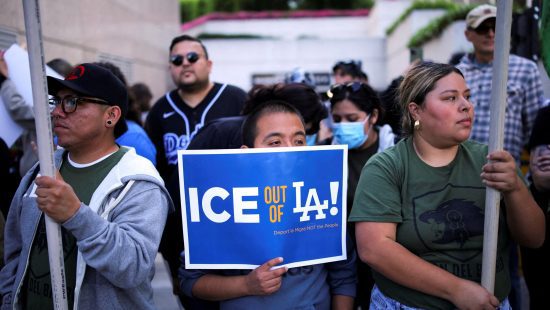
Outside the courthouse—as happens whenever there is a hearing for the case—a dozen Chalco residents are demonstrating for Carlota’s freedom. Sheltered from the sun under a canopy, men and women shout slogans: “Justice! Justice!” and “You are not alone.” They hand out flyers to motorists and passersby about the new anti-eviction movement while listening to the *corrido* of Doña Carlota, a song that tells the story for which she has become famous.
In short, on that day—April 1, 2025—Carlota (then 74 years old) went to the home of her daughter, Mariana, in the Ex Hacienda de Guadalupe neighborhood of Chalco, to take matters into her own hands. Mariana and her brother Eduardo had spent days trying to oust a group of squatters who had moved onto their property. They had already filed a formal complaint with the Public Prosecutor’s Office, but the only result was a visit on March 28 by State of Mexico forensic experts and investigative police; these officials merely confirmed that the house had been secured with chains and padlocks that did not belong to the legitimate owners.
The police, however, did not remove the occupants. Three days later, Carlota and her children returned home to find the squatters, who refused to leave. After a heated argument, Carlota and Eduardo drew their weapons and demanded they leave; eventually, Carlota opened fire, killing a 51-year-old man and his 19-year-old son, and wounding a minor.
A witness recorded the scene on her cell phone, and the video quickly went viral on social media, giving rise to the legend of the “avenging grandmother.” In a metropolis with over 60,000 cases of property dispossession and squatting on file with the State of Mexico and Mexico City prosecutors’ offices, the story transcended the homicide itself to become a symbol: that of a citizen taking justice into her own hands in the face of official ineptitude.
Carlota, Mariana, and Eduardo were arrested days later and prosecuted for the double homicide, despite claiming self-defense. Two of the alleged squatters were also jailed, charged with dispossession, home burglary, and extortion. In March 2026, Carlota’s defense team filed an *amparo* petition to have her precautionary measures modified, citing her age and health; she currently remains under house arrest—wearing an ankle monitor—in a housing complex in Chicoloapan, a municipality neighboring Chalco.
Doña Carlota has become a media legend, fueled by thousands of people who have themselves been victims of property dispossession. Her supporters abound on Facebook and YouTube, where the video of the shooting continues to rack up views and “likes.”
Family members and neighbors appear at the courthouse within the Chalco Penitentiary and Social Reintegration Center whenever a public hearing is scheduled. The trial, as is typical in Mexico, is proceeding slowly, at the whim of the presiding judge in the Chalco judicial district and a prosecutor’s office that has delayed the presentation of evidence.
At the demonstrations, *corridos* and *cumbias* dedicated to Doña Carlota are played; their lyrics serve as veritable glorifications of the very crime for which she could be sentenced to 84 years in prison. As part of the protest performance, demonstrators carry banners featuring an image of a grandmother dressed as Batman. “We are all Carlota. No more invasions!” reads the text in yellow and white letters against a deep maroon background—the signature color of the Morena party.
From citizen justice to the institutional response
Arturo Santana Alfaro is Doña Carlota’s son and a lawyer representing his mother and siblings in the case. He served two terms as a federal deputy for the PRD during the years when the current leaders of Mexico City and the State of Mexico were also active members of that party—once the standard-bearer of the Mexican left. He is the primary spokesperson for the Doña Carlota Movement. He attends hearings dressed in a suit and tie, armed with a Code of Criminal Procedure and a printed copy of the case file, all jumbled together inside a folder. He wears glasses and speaks with calm eloquence.
“The Doña Carlota movement formed organically to help people who have been dispossessed of their properties—not just their homes, but their land, offices, and so on,” Santana explains.