“This is special to me. I really enjoy having my daughter Sofía accompany me and participate in the activities. Watching her grow alongside me is a great gift from life.”
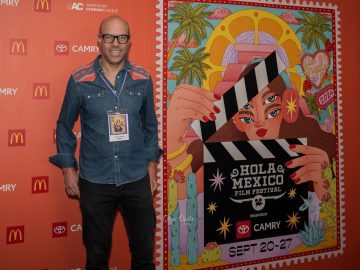
The Los Angeles-based musician known as Jarochelo returns to his family’s Veracruz community each August, teaching children son jarocho while using music to reconnect migrants with the places they call home.
The children wait for him every year when August arrives. They know César Castro will return from the North to their community, where five years ago he began a cultural outreach program designed to nurture Tlalixcoyan’s musical roots and create a cultural space for local children during this important part of the summer.
He does more than take out his jarana. He does more than challenge them with versada exercises. He also shares time with them in the park, where playing soccer reinforces the importance of migrants who return to “their home” and build a bridge between their communities of origin and the communities where they now live around the world.
“It is very important. There are many ways to contribute. If you have the opportunity, you have to return to your communities and share what you have built. In my case, this project began as a tribute to my parents’ homeland and became a cultural project that seeks to revive the roots of son jarocho in these lands. It has been five years. Every year brings new difficulties, but we move forward. It gives me tremendous joy to see how people have embraced this project and how the children continue to progress,” says César Castro, known as Jarochelo through his various projects.
The children wait for him every year when August arrives. They know César Castro will return from the North to their community, where five years ago he began a cultural outreach program designed to nurture Tlalixcoyan’s musical roots.
He is also the director of the son jarocho group Cambalache and sees this program as a personal commitment.
“I wouldn’t trade it for anything. Every year, from August 1 through August 17, my commitment is to this community. There is no room for anything else,” he says.
It is easy to say, but making such a commitment is anything but simple.
Jarochelo is a well-known cultural promoter of son jarocho among Latino communities, particularly in East Los Angeles. In addition to making jaranas, organizing events, teaching classes in community centers and prisons, performing concerts and, more recently, providing his sound system for different events and countless other activities, he continues to reaffirm his commitment to the community and to sharing the music of his homeland.
César Castro is a true Veracruz native, friendly and easygoing, with an infectious laugh and always willing to help in whatever way he can. He has been deeply affected by what has happened in Boyle Heights, where he has worked for so many years and has countless friends.
“I think that for us musicians and music promoters, Boyle Heights is a fundamental part of our lives. Everyone who does this kind of work has passed through here. It hurts to see what has happened.”
Organizing this year’s workshop in Tlalixcoyan has been difficult, but it has also received more support. Ricardo Santiago, the event’s cofounder and coordinator, is always there to help, along with the teaching team: Ana Zarina, who teaches versada; Jhosmar Zamudio, who teaches requinto; Miguel Segarra, who teaches singing; Samir Azamar, who teaches percussion; Luisa Hernández and Doña Alicia Hermida, who oversee the culinary presentation; and volunteers Bety Delgado, Xocoyotzin and Apatzingán Santiago Delgado, Johana Delgado, Juan Ramón Arenas, Rosita Rodríguez, Martha González, Cointa Castro and Doña Irene Uscanga Valencia.
“It is very important to recognize all of them and the families who have contributed. Look, this has become a great collective effort, a truly community effort, and because of that, it is difficult not to have a positive result. During the weeks we spend there, we have built a community. People look forward to it, they enjoy it, and every year we add more activities.
“This is special to me. I really enjoy having my daughter Sofía accompany me and participate in the activities. Watching her grow alongside me is a great gift from life. At night, over coffee and a little bread, we talk about the children who have improved, those who have overcome their shyness, who now dare to improvise verses, who dance more, who have become more skilled dancers. It is so special,” he adds.
Jarochelo has extensive experience as a teacher. From the beginning, he has found it easy to recognize children’s talent, see how they progress and identify when they have achieved important milestones.
The “Playing with Rhyme” Versada Class.
“There are two children, two brothers, Elio and Altair Domínguez, who surprised me this year. They had tremendous talent for versada. They and some of the others could go toe to toe with the teachers. Those are important advances. There was one girl, you should have seen how she played the jarana. Incredible. Five years ago, all of this was foreign to them. Now it is part of their lives,” he says.
For César, being a migrant carries another meaning and another responsibility.
“If you are a migrant, you will get tired of just going to resorts or going places as a tourist. It is essential to give something back to the communities we left behind. The question, ‘How can I contribute?’ always has to be answered. Giving that exchange meaning gives purpose to your place as a migrant. Being a migrant also means being part of the roots, going back and paying your dues to your homeland,” he says.
The end of the course is always emotional. The experiences and interactions come to an end, but the memories remain, along with the sounds, laughter, jokes, instruments and the atmosphere that fills the community during those days.
Conjunto Tlalixcoyan sharing sones with the fifth-year students.
“I don’t think anything brings more joy than when, at the end, the children start playing, and the teachers look at one another and say, ‘Yes, it sounds good! They’re playing!’ They are more confident, less inhibited, and more eager to show their talent,” he says excitedly.
Jarochelo is a modern-day juglar, a wandering troubadour of another era. One can imagine him walking those dusty roads with his back turned, head held high and a smile on his face. He dreams as he walks, dreams as he plays, dreams while awake and while asleep, and now he shares those dreams with this community. This juglar does not think about himself. Selfishness has no place in his vocabulary.
“I dream of this community becoming a musical reference point. I dream of them having music teachers. My dream is rooted in education, in their development.
“On the day of the final session, there are so many mixed emotions. One little girl cried so much that she had to leave. She was crying with an ancestral pain. An elderly woman gave me a blessing unlike anything I had ever received before. Those are the things that stay with you.
“And so will the memory of when my daughter and I were on the plane returning home. We cried. We couldn’t hold it back. ‘It’s over,’ I told her,” he adds.