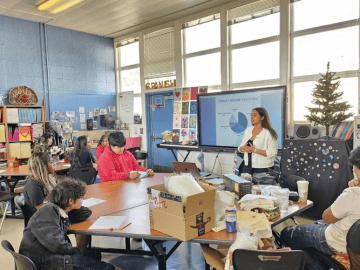
A UC Berkeley study found that early education gains lasted into elementary school, but home language, preschool experience and school resources shaped the results.
For many California parents, the decision to enroll a child in preschool or transitional kindergarten comes with a simple hope: Give them a good start.
Maybe that means learning to recognize letters, becoming comfortable in a classroom or making friends before kindergarten begins.
But parents also want to know something harder to measure: Will that early start still matter years later?
New research from UC Berkeley suggests it can.
Researchers followed more than 1.6 million California children and found that early education investments were linked to substantial improvements in reading and mathematics that lasted into third and fourth grade.
Yet the most revealing finding may be that not every child benefited in the same way. What children experienced before transitional kindergarten, the language spoken in their homes and the resources available at their elementary schools all helped shape their progress.
The study, published through the Learning Policy Institute on October 21, examined students who entered kindergarten between 2011 and 2014, with outcomes tracked through 2019.
The benefits didn’t disappear after kindergarten
The researchers examined three major California education changes: expanded state preschool, the introduction of transitional kindergarten (TK), and increased funding for elementary schools.
Children exposed to the broader reforms performed nearly 11 months ahead in reading and about eight months ahead in mathematics by third and fourth grade, compared with similar students from earlier cohorts.
Those figures are statistical estimates expressed as months of learning. They do not mean every child gained exactly that much, and they reflect several reforms working together—not TK alone.
When researchers isolated TK’s effects, they found particularly strong results for children from low-income families whose parents spoke English.
By third grade, those children showed approximately seven additional months of learning in reading and mathematics compared with similar children who had not attended TK.
That is meaningful progress. But the study also found that an early classroom experience, by itself, was not the whole story.
Why did home language make a difference?
For children from low-income households where parents did not speak English, the estimated benefits of TK alone were smaller.
The picture changed when children had attended the California State Preschool Program at age three before moving into TK.
Among low-income multilingual learners, researchers found approximately half a year of additional learning in fourth-grade mathematics associated with that earlier preschool experience.
For families who speak Spanish or another language at home, this finding deserves careful explanation.
It does not mean children are disadvantaged because their families speak another language.
The children in this study attended school during a period when California restricted bilingual instruction. Some may not have received the language support they needed as they moved through the early grades.
Researchers suggest that state preschool may have offered additional opportunities to develop language skills and learn in more familiar settings.
They also acknowledge an important limitation: Families who enrolled children in preschool at age three may have differed from those who did not. The results cannot establish that attending two programs, by itself, caused the entire difference.
Still, the findings raise a practical question for Los Angeles families: When a young child is learning English while developing skills in another language, does the classroom have the teachers, materials and support to help that child succeed?
That question extends beyond preschool. We have reoported on concerns about teacher preparation and support for English learners in Los Angeles, including the challenges multilingual families face when schools lack sufficient resources.
What happens after TK matters just as much
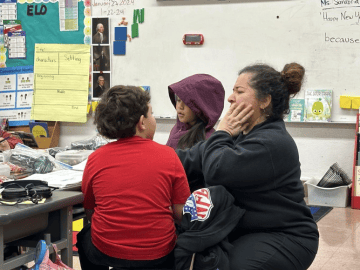
Imagine two children who both have a strong year in TK.
One moves into an elementary school with enough teachers, instructional support and learning materials to build on that progress. The other enters a school struggling to provide the same resources.
Their early education may have been similar. Their opportunities afterward may not be.
That is another important finding from the Berkeley research.
For low-income children whose parents spoke English, TK was associated with approximately four to five months of additional third-grade learning in lower-spending schools, compared with nearly 10 months in higher-spending schools.
The researchers also examined California’s Local Control Funding Formula, which provides additional funding based on students’ needs, including low-income status and English learner enrollment.
They found that early education gains were generally stronger and lasted longer when children subsequently attended better-resourced elementary schools.
In other words, a promising start could be strengthened—or gradually weakened—by what happened in later classrooms.
This connects to a larger challenge Parriva has covered: why achievement gaps affecting California’s Latino students persist despite major education investments.
The new study adds an important piece to that discussion. Expanding preschool access is important, but maintaining the gains also requires attention to the schools children attend afterward.
Does this tell us whether today’s universal TK is working?
Not yet.
The children in the study entered kindergarten between 2011 and 2014. Their academic progress was tracked through 2019, before the pandemic and well before California completed its expansion of universal TK.
Beginning with the 2025–26 school year, California made TK available to all age-eligible four-year-olds. Parriva’s guide to California’s universal TK program explains enrollment eligibility, free school meals and the practical questions families should consider.
That expansion creates opportunities for many more children. It also creates new challenges for school districts, including hiring qualified teachers, supporting multilingual learners and maintaining classroom quality as enrollment grows.
The Berkeley researchers used several statistical methods and checks to strengthen their conclusions. But their findings concern an earlier education system, not a direct evaluation of every TK classroom operating today.
What should parents ask?
For parents exploring TK or preschool, the research points to questions worth bringing to a school visit or enrollment conversation.
How does the classroom support children who speak another language at home? Are teachers trained in early childhood development? How are families kept informed about progress? And what happens when children move from TK into kindergarten and first grade?
Parents of three-year-olds can also ask about eligibility for the California State Preschool Program.
No single classroom, program or teaching method guarantees a child’s future academic success.
But the Berkeley findings offer a useful reminder: A strong start matters most when schools continue building on it.
For California families, the promise of early education is not simply that a child gets a place in a TK classroom. It is that the opportunity continues as that child grows.