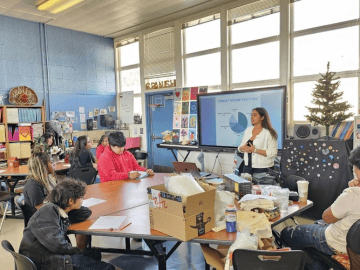
A major review of California’s education system finds progress in funding and access, but many Latino students still face barriers tied to poverty, language support, and uneven school resources.
California has spent more than a decade trying to build a fairer public education system. It has increased funding for higher-need students, expanded early childhood education, invested in literacy programs, and created new policies aimed at closing achievement gaps.
Yet a major review of the state’s education system finds that many Latino students continue to fall behind academically.
That matters because Latino students now make up the largest share of California’s public school population. When Latino students succeed, California succeeds. When they struggle, the state’s workforce, economy, and future prosperity are affected.
The findings come from the latest Getting Down to Facts research initiative, a comprehensive examination of California’s K-12 education system conducted by leading researchers from universities and policy organizations across the state.
The report reaches a difficult conclusion: California has made meaningful progress on educational equity, but progress has not translated into equal outcomes.
Researchers found persistent achievement gaps based on race, ethnicity, income, and English Learner status. Those categories overlap significantly with California’s Latino population.
For many Latino families, the issue is not simply what happens inside the classroom. Educational outcomes are closely connected to family income, housing stability, healthcare access, neighborhood resources, and access to early childhood education.
In other words, education inequality often reflects broader economic inequality.
Top Findings
- Latino students remain disproportionately affected by achievement gaps.
- Many children enter kindergarten already behind academically.
- English Learners continue to face significant barriers.
- California has improved funding equity through the Local Control Funding Formula.
- School districts often struggle to implement reforms effectively.
- Educational opportunities still vary significantly by ZIP code.
- Researchers say stronger accountability and coordination are needed.
California Has Invested Billions. What Improved?
The report does not argue that reforms have failed.
In fact, researchers found several areas where California has made notable progress.
The state’s Local Control Funding Formula (LCFF) directs additional funding toward low-income students, English Learners, and foster youth. Because Latino students are heavily represented in these groups, many communities have benefited from increased investment.
California has also expanded preschool access, strengthened academic standards, invested in literacy initiatives, and increased support for community schools.
Researchers point to growing evidence that high-quality early childhood education can help reduce learning gaps before they become deeply entrenched.
Those investments matter because many educational disparities begin long before students enter first grade.
One of the report’s most important findings is that many students arrive at kindergarten already behind.
Children who begin school with weaker literacy, language, or math skills often face challenges catching up later.
This has major implications for Latino families.
Latino children are more likely to come from lower-income households and may face barriers related to childcare access, preschool availability, housing instability, or language support.
Researchers emphasize that addressing achievement gaps in high school is often much harder than preventing them during early childhood.
The report identifies a recurring problem.
California is often effective at creating ambitious education policies. It is less effective at ensuring those policies are implemented consistently across thousands of schools and hundreds of districts.
Researchers found many districts struggle with:
- Staffing shortages
- Teacher training needs
- Administrative capacity
- Program implementation
- Accountability systems
As a result, reforms that look promising on paper may not produce the same results for students across different communities.
A Latino student in one district may have access to strong academic support programs, while a student in another district may not receive the same opportunities.
The Issues the Report Barely Addresses
While the report focuses heavily on educational equity, it spends relatively little time examining several realities that affect many Latino families.
One is immigration-related stress.
Across California and Los Angeles County, many students live in mixed-status households. Fear of immigration enforcement, uncertainty about family stability, and anxiety within communities can affect attendance, mental health, and engagement with schools.
Another underexplored issue is housing affordability.
Rising rents, overcrowded housing, displacement, and homelessness can make it harder for students to maintain consistent attendance and academic performance.
Many educators say these pressures increasingly shape classroom outcomes, particularly in high-cost regions such as Los Angeles.
The report also provides limited discussion of how parents working multiple jobs or irregular schedules can affect family engagement with schools.
Why This Is Also an Economic Story
Education is often discussed as a school issue. It is also an economic issue.
Lower educational attainment is associated with lower lifetime earnings, reduced career mobility, and fewer opportunities in sectors that increasingly require technical skills and postsecondary training.
For California’s economy, the stakes are enormous.
Today’s students will become tomorrow’s workforce.
If large achievement gaps remain, they can contribute to future wage inequality, labor shortages, and reduced economic growth.
For Latino-owned businesses, workforce readiness affects hiring pipelines, entrepreneurship, and long-term competitiveness.
For families, educational outcomes can influence housing opportunities, healthcare access, and financial security.
Researchers argue that California’s challenge is no longer simply creating new equity programs.
The next challenge is ensuring those programs consistently deliver results.
That means improving accountability, strengthening district capacity, supporting teachers, expanding early childhood education, and identifying which interventions are producing measurable gains for Latino students.
The larger question remains unresolved:
If California has spent years pursuing educational equity, why do so many achievement gaps persist?
The answer may not be funding alone. Researchers suggest the state’s future success will depend on how effectively it translates policy promises into classroom realities.
For Latino families, that outcome will help determine not only educational opportunity, but economic opportunity for an entire generation.