After losing his business during the pandemic, South Central entrepreneur Josue Calderón rebuilt his life around two businesses, his community and a belief that giving up is not an option.
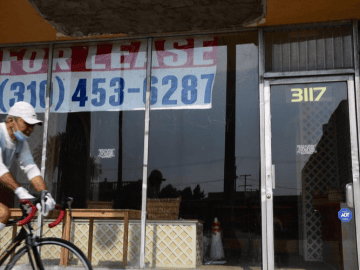
When the pandemic hit, Josue Calderón felt like everything had come to an end. He had to close his business in South Central and fell into a depression, suffered anxiety attacks, and everything he had fought for up to that point in his life came crashing down. He knew he had fallen, but he also knew he had to get back up.
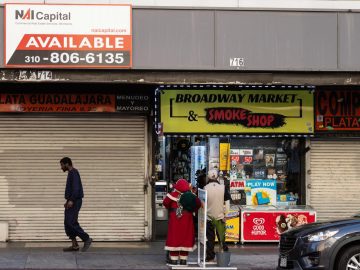
Calderón, nicknamed “El Buki” by his close circle, now owns two businesses in South Central: Melody Rose La Casa de los Ositos Gigantes y Joshua Montalvo Instruments, a gift shop where giant teddy bears sell best around Valentine’s Day. He’s originally from Otlatepec, Guerrero, and just as he trusted in his own ability to get back on his feet, he placed that same trust in staying in this part of Los Angeles he now calls home.
“It’s a beautiful area, it’s growing. We know there are a lot of problems, you leave home in the morning with the fear that you might get robbed, but I would never think of leaving this area. I try to give the best of myself and work together with the rest of the community so we can move forward,” Calderón says.
Born to Sell
Calderón was always like this, a fighter, and good at sales, since his childhood in Otlatepec.
“I learned it from my parents. My mom had a little stand where she sold whatever she had, if there were chickens, I’d go out and sell chickens. We’re born sellers. I was the only one who sold everything I was given, you need a lot of charisma, and I had it. You need to have no shame to sell, to go out into the street, a salesperson can’t stay locked up inside, you have to go out and get to know your customers. I knew that since I was a kid,” he says.
That charisma followed him into adulthood, he once had six girlfriends at the same time, and managed to convince all of them. When he arrived in Los Angeles years later, he dated an English-speaking girl without knowing a word of English himself. “I won her over with pure gestures,” he says.
He arrived in Los Angeles at 14, and like any immigrant, everything felt foreign, worlds away from his hometown in Guerrero’s “tierra caliente.” “My mom brought us here to get ahead, to see if we could have a better life. It was very hard for me, the hardest part was the English,” he says. He made it through 11th grade before his father returned to Mexico, leaving Josue to figure out how to support his mother and sister. “When we got here, we started selling little guitars. That’s how we are in my family, we don’t look for work, we create it. I have never in my life worked for anyone,” he adds.
At 20, he moved with his family to South Central. He adapted quickly and started thinking about what business to open next. The idea came out of nowhere: giant teddy bears. “Nobody sells this,” he told his mother. He got to work.
Building More Than a Business
“I wanted to be stable, opening a business was what I needed,” he says. “People accepted me and I kept growing. I also had the guitar business. That’s how I became part of the community, I taught kids how to play piano and guitar, and how to sing too. Back then, I’d go outside my store to sing and dance. People liked it, they’d stop to listen to me.”
That sense of stability didn’t come without cost. In the years he’s spent building his life in South Central, Calderón was assaulted and left badly hurt, an attack over a hundred dollars that he says left him with serious, lasting injuries to his head. He recalls it matter-of-factly, the way someone recalls something they’ve made peace with, but not forgotten.
“I love my business, my community, so much,” he says.
“We Are Fighters”
The pandemic forced him to adapt all over again. “It’s hard to stay afloat, we live day to day, it’s our daily bread… We keep fighting. But we’re fighters, we entrust ourselves to God,” Calderón says. “South Central isn’t easy. A lot of people are arriving, our community is affected by drugs, alcohol, police activity, it scares people off. But we have to keep going.”
He wishes police would focus more on protecting the community than instilling fear in it. “They treat neighbors harshly and would rather not interact with them at all,” he says, a tension he doesn’t resolve so much as live inside of, wanting more safety while distrusting how it’s often delivered.
He believes city leaders have long pushed businesses like his aside. “In these difficult times is exactly when we should be getting more help. Small businesses are the ones who keep the economy moving. We need to make noise, get our streets fixed, more security put in place, cultural centers opened,” he says. He once wrote a letter to then-councilman Curren Price asking for something to promote local culture and give the neighborhood’s children somewhere to belong.
Now, with a new election ahead, Calderón is watching closely. “I have a lot of faith in (José) Ugarte, he has a fresh mindset,” he says. “If Ugarte wins, he’s going to face an enormous challenge. I hope South Central can reinvent itself. It deserves it. We have a great community.”