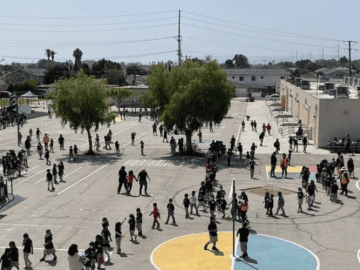
Enrollment has fallen dramatically over two decades. In many Los Angeles communities, schools provide more than education—they provide meals, after-school programs and a place for children to spend time while parents work.
For a child, the school day may end when the final bell rings.
For a working parent, it may not.
The school may be where a child eats breakfast and lunch. It may be where they stay for an after-school program until a parent gets off work. It may be where they receive tutoring, play sports or spend several more hours in a supervised environment.
That makes the dramatic decline in enrollment at the Los Angeles Unified School District about more than empty classrooms.
What happens to a community when the institution built around its children begins to shrink?
LAUSD’s enrollment has been falling for more than two decades. A comparable enrollment analysis by Great Public Schools Now, using California Department of Education and LAUSD data and excluding independent charter schools, puts enrollment at 724,113 students in 2002–03. The district projects 375,661 students by 2027–28.
That represents a decline of about 348,452 students, or 48%, from the 2002–03 figure.
The numbers are staggering. But they don’t tell the entire story.
More than a classroom
For many LAUSD students, the school day includes meals.
Under California’s Universal Meals program, LAUSD says every student is entitled to free breakfast and lunch each school day. The district also provides supper at participating schools after the instructional day.
The cafeteria, therefore, is more than a place where students eat between classes. It is part of the infrastructure that gets children through the day.
Latino students make up roughly 73% of LAUSD enrollment, making the district’s transformation particularly significant for Latino Los Angeles.
But it would be misleading to say that Latino families as a group depend on school meals. That requires family-level evidence.
The better question is: How important are those meals to the families who use them?
The same question applies after school.
LAUSD’s Beyond the Bell programs provide free before- and after-school activities that can include academic support, sports, arts and recreation. Programs at participating campuses can extend into the evening.
For a parent who works until 5 p.m., that can make a practical difference.
The school day may end at 3.
The workday may not.
An after-school program is not simply “babysitting.” But for some working families, it can help bridge those two schedules.
A shrinking system
Declining enrollment is also creating a financial challenge for LAUSD.
Fewer students do not necessarily mean that every cost falls proportionately. The district still has buildings, cafeterias, transportation, special education, counselors, athletic facilities and other infrastructure to maintain.
LAUSD has already approved major budget reductions as it responds to declining enrollment and other financial pressures.
That raises questions beyond the number of empty desks.
What happens to the cafeteria when fewer children are eating there?
What happens to after-school programs?
What happens to sports, clubs and enrichment?
And what happens to families that have built their daily routines around those services?
Not every program disappears when enrollment falls. But maintaining a large public-school system with substantially fewer students becomes increasingly difficult.
A Latino Los Angeles story
The enrollment decline should not automatically be interpreted as Latino families leaving Los Angeles.
Families move. Some choose charter or private schools. Others enroll their children in neighboring districts. And California’s declining birth rate means fewer children are entering the school system.
But because Latino students represent such a large share of LAUSD, the district’s transformation is also a story about Latino communities.
The most important voices may therefore be the families themselves.
Ask a parent who works until 5 p.m.:
What happens to your child after school?
Ask another:
Does your child eat breakfast or lunch at school?
Ask:
What would your family have to do if the after-school program disappeared?
Those answers can reveal something that enrollment spreadsheets cannot.
The bigger question
LAUSD could lose nearly half of the students it had at its comparable 2002–03 peak by 2027–28.
The immediate consequence is obvious: fewer children in classrooms.
But a school can also be a cafeteria, a playground, a library, a sports field and an after-school center.
For many families, it is part of the infrastructure of daily life.
And as LAUSD shrinks, Los Angeles may have to confront a question that goes beyond enrollment:
What can a community afford to lose when the institution built around its children becomes smaller?