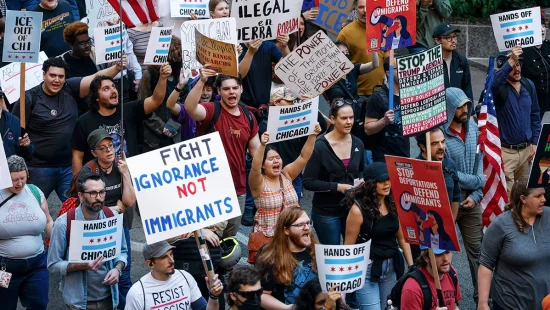
New polling suggests Americans still want immigration laws enforced, but growing numbers are questioning mass deportation, aggressive tactics and how enforcement is being carried out.
When Donald Trump returned to the White House, he did so with a clear political argument on immigration: voters had demanded tougher enforcement, stronger border security and a major increase in deportations. Immigration had been one of the defining issues of the 2024 presidential campaign, and the administration has repeatedly pointed to that election as evidence that Americans wanted a dramatic change in federal immigration policy.
But an election mandate is not necessarily permanent.
Public opinion can change after an election. Events can change it. Government actions can change it. And new polling in 2026 suggests something important is happening on immigration: Americans have not necessarily abandoned the idea of enforcement, but many are becoming increasingly uncomfortable with the way enforcement is being carried out.
That distinction could become politically important.
For years, immigration polling has often been presented as a simple choice: tougher enforcement or less enforcement.
The newer data suggest the public’s views are more complicated.
A March 2026 University of Massachusetts Amherst national poll found that 54% of Americans disapproved of President Trump’s handling of deportations of undocumented immigrants. Support for some of the administration’s more aggressive approaches was even lower. Only 13% supported deporting undocumented immigrants to a country other than their country of origin, while support for separating undocumented immigrant parents from their children during enforcement proceedings had fallen to 11%.
That does not mean Americans want the government to stop enforcing immigration laws.
It means many Americans appear to be drawing a line between enforcement as a principle and the methods used to enforce those laws.
That may be one of the most important changes in the immigration debate.
The distinction becomes clearer when looking at broader polling.
A Gallup survey conducted in June 2025, while not a 2026 poll, provides an important baseline for understanding the direction of public opinion. Gallup found that support for deporting all undocumented immigrants had fallen to 38%, down from 47% the previous year. At the same time, support for allowing undocumented immigrants to become U.S. citizens if they meet certain requirements increased to 78%.
The Gallup data also showed a particularly significant movement among independents. Support among independents for deporting all undocumented immigrants fell from 41% in 2024 to 31% in 2025, while support for a pathway to citizenship increased from 72% to 79%. Gallup:
That matters because it challenges one of the simplest assumptions in the current political debate.
The choice may not be between enforcement and no enforcement.
Increasingly, the public appears to be asking a different question:
What should immigration enforcement look like?
The public’s confidence in ICE is another warning sign
The shift is also visible in attitudes toward Immigration and Customs Enforcement.
A July 2026 Economist/YouGov poll found that 58% of Americans believed ICE had used too much force, compared with 30% who said the agency’s use of force had been necessary and justified. The survey also found that only 12% of independents said they had a great deal of confidence in ICE, compared with 54% of Republicans.
The significance is not simply that ICE has become unpopular among Democrats.
It is that skepticism extends beyond the Democratic base.
Independents are particularly important because they occupy the political space that often determines whether a policy remains broadly acceptable outside a party’s core supporters.
When independents begin separating support for immigration enforcement from support for the government’s enforcement tactics, politicians face a different political calculation.
This pattern was already visible in earlier 2026 polling.
A March 2026 PRRI survey found that only 35% of Americans viewed Trump’s handling of immigration favorably, while 61% viewed it unfavorably. Among independents, only 26% held favorable views of ICE officers, down from 34% in September 2025. PRRI: Survey Finds 6 in 10 Americans View Trump’s Handling of Immigration Unfavorably
PRRI’s research also found that support for Trump’s handling of immigration had declined across partisan groups, with independents showing some of the sharpest movement.
That does not mean independents have suddenly become uniformly supportive of a Democratic immigration agenda.
It means something more complicated may be happening: voters who previously supported stronger enforcement may not necessarily support every policy being implemented in the name of enforcement.
That distinction could become increasingly important as lawmakers defend the administration’s policies.
An election gives politicians a mandate. It does not freeze public opinion.
This is where the debate becomes larger than immigration.
In a representative democracy, elections are one way voters give politicians permission to pursue a particular direction. A president and members of Congress can reasonably point to their election victories as evidence that voters supported at least some of the agenda they campaigned on.
But elections are snapshots.
Public opinion continues to move after Election Day.
A politician elected on one issue cannot assume that every subsequent policy will retain the same level of public support simply because the politician won.
That is especially true when the policy itself produces new experiences for voters.
Immigration enforcement is an unusually visible example. People can debate border security in the abstract. But opinions can change when voters see images of arrests, hear stories about detention, learn about enforcement operations in their communities or begin questioning who is being deported and how those deportations are being carried out.
The 2026 polling suggests that some of that reassessment may already be happening.
The most important takeaway is therefore not that Americans have suddenly become opposed to immigration enforcement.
The evidence does not support that conclusion.
Instead, the country appears to be moving toward a more complicated position: Americans can support secure borders and enforcement of immigration laws while opposing particular deportation policies, excessive force, family separation or enforcement methods they believe go too far.
The UMass findings illustrate that distinction clearly, while the YouGov polling shows growing concerns about ICE tactics and confidence in the agency.
That creates a potential political vulnerability for the administration and congressional Republicans.
Not necessarily because voters have rejected immigration enforcement.
But because politicians who continue to describe every aggressive enforcement policy as part of an existing electoral mandate could eventually find themselves out of step with voters who supported enforcement but have changed their minds about where its limits should be.
What happens when the mandate and the public separate?
That is the question Washington now has to answer.
The administration and its congressional allies can continue arguing that the 2024 election gave them a mandate to pursue aggressive immigration enforcement.
But voters are not required to keep the same opinion for four years.
If public support continues moving away from mass deportation and aggressive enforcement tactics, lawmakers will eventually face a choice: adjust their policies to reflect changing public opinion, or continue forward and ask voters to judge those decisions at the next election.
And that is where polling matters.
Polls do not tell politicians exactly how people will vote. They cannot predict the future with certainty, and immigration will compete with the economy, inflation, health care, crime, education and other issues for voters’ attention.
But polls can provide something else that matters in a democracy: a warning that the public’s position may be changing.
The question for Washington is whether lawmakers listen before voters get their next chance to speak.
For now, the data suggest that the immigration mandate Republicans won in 2024 may not look exactly the same in 2026.
And if that gap continues to grow, the next immigration debate may not be about whether America wants enforcement.
It may be about whether Washington is still listening to what Americans say that enforcement should look like.