A new synthetic opioid has been detected in California, including in a fatal San Francisco case, raising a new public-health concern even though Los Angeles County has not publicly confirmed a cychlorphine-related death.
The drug, called cychlorphine, has been identified in toxicology testing in multiple states. Laboratory research indicates it is substantially more potent than fentanyl, while standard fentanyl test strips do not detect it.
That creates a particularly difficult problem: someone can test a drug for fentanyl, receive a negative result and still be exposed to a dangerous synthetic opioid.
What is cychlorphine?
Cychlorphine, also known as N-propionitrile chlorphine, is a synthetic opioid first identified in the United States in 2024.
The Center for Forensic Science Research and Education has linked the drug to fatal overdoses and reported laboratory evidence indicating potency roughly 10 times greater than fentanyl. That comparison comes from laboratory pharmacology data, rather than a direct measurement of how much more likely the drug is to cause death in humans.
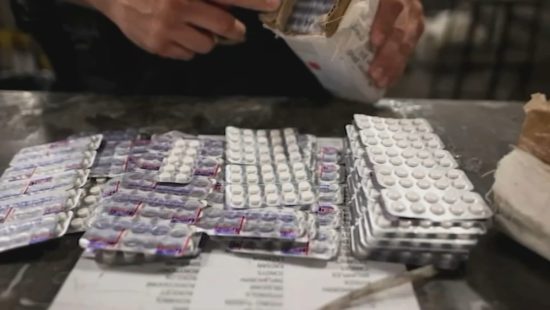
The drug has been found in counterfeit pills and other illicit substances, meaning people may be exposed without knowing what they are taking.
San Francisco health officials reported the city’s first known fatal overdose involving cychlorphine in April. The victim had taken counterfeit pills, and officials warned that standard fentanyl test strips would not detect the drug.
The case has since produced a significant new development. San Francisco police announced Sept. 14 that four people had been arrested following an investigation into counterfeit pills connected to the teenager’s death, with more than 20,000 pills seized. Investigators also found cychlorphine in counterfeit pills from earlier investigations.
That makes California different from states where cychlorphine had previously been viewed primarily as an emerging national threat.
But there is an important distinction for Los Angeles.
There is no publicly confirmed cychlorphine-related death in Los Angeles County as of this writing.
That does not establish that the drug is absent from the region. It means there is currently no publicly documented case that can establish its presence in an LA County death.
One of the biggest concerns surrounding cychlorphine is that standard fentanyl test strips do not detect it, according to forensic researchers and San Francisco health officials.
That means a negative fentanyl-strip result cannot be interpreted as proof that a drug is free of dangerous synthetic opioids.
For people who use illicit drugs, particularly counterfeit prescription pills or drugs obtained from an unregulated source, that distinction can be critical.
The DEA has warned that the illicit drug supply is increasingly being mixed with emerging synthetic substances, creating unpredictable overdose risks.
Naloxone still matters
Cychlorphine does not make naloxone, commonly sold as Narcan, irrelevant.
Health officials say naloxone should be administered in any suspected opioid overdose, including cases that may involve cychlorphine. Multiple doses may be necessary in some overdoses.
Parriva has in onother ocassion explained how California residents can obtain Narcan and why having it available matters.
Anyone who suspects an opioid overdose should administer naloxone if available and call 911. Signs of an overdose can include slowed or stopped breathing, inability to wake the person and blue or gray lips or skin.
Because the substance involved may be unknown, having more than one dose of naloxone available can be especially important.
Cychlorphine also presents a serious risk for people who have recently stopped using opioids or completed treatment.
After a period of abstinence, opioid tolerance can fall. Returning to a previous dose can therefore become dangerous even before considering the possibility that the drug supply contains a substantially more potent substance.
Counterfeit pills and adulterated drugs add another layer of uncertainty because a person may believe they know what they are taking when they do not.
Parriva has also reported on the changing pattern of fentanyl deaths and treatment, part of the broader shift in the illicit drug supply that makes emerging synthetic opioids important to watch.
What Los Angeles knows and doesn’t know
For Los Angeles County, the most important fact right now is also the simplest:
California has documented cychlorphine, but Los Angeles has not publicly confirmed a case.
There is not enough evidence to say the drug is already widespread in Southern California. Nor is there enough evidence to assume that it is not present.
That uncertainty is precisely why continued toxicology surveillance and rapid public-health communication matter.
For families, people in recovery and anyone who uses illicit drugs, the practical lesson is to treat the drug supply as unpredictable, carry naloxone when possible and never assume that a negative fentanyl test rules out every dangerous opioid.
Cychlorphine may or may not become a major problem in Los Angeles. What California’s recent cases show is that the region has a reason to be prepared before it has a reason to panic.
This is a sensitive public health topic. If you or someone you know is struggling with substance use, the SAMHSA National Helpline (1-800-662-4357) offers free, confidential support and referrals, available 24 hours a day.