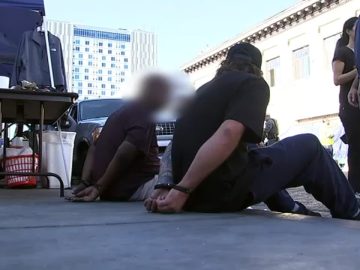
Overdose deaths in Los Angeles County fell for the third consecutive year, but people living in the poorest communities continued to face overdose death rates several times higher than residents of wealthier areas.
Los Angeles County is seeing a welcome decline in drug overdose deaths. But the latest numbers also point to a persistent divide: where you live and how much money your community has can still make a major difference in your risk of dying from an overdose.
The county recorded 2,298 accidental drug overdose and poisoning deaths in 2025, a 6 percent decline from 2024 and nearly 30 percent below the peak of 3,220 deaths in 2022. Fentanyl related deaths fell 10 percent last year, while methamphetamine related deaths fell 7 percent. It was the third consecutive year that overdose deaths declined.
But the improvement does not erase one of the clearest patterns in the county’s data. Residents living in high poverty areas continued to have the highest overdose death rates in 2025, according to the Los Angeles County Department of Public Health.
In 2024, the overdose death rate in areas where more than 30 percent of families lived below the federal poverty level was 63.5 deaths per 100,000 people. In areas where fewer than 10 percent of families lived below the poverty level, the rate was 17.8 per 100,000.
That means residents of the poorest areas faced an overdose death rate 3.6 times higher than residents of the most affluent areas.
The same pattern appears in the county’s fentanyl data.
In 2024, the fentanyl overdose death rate in the poorest areas was 39.1 per 100,000, compared with 10.0 per 100,000 in the most affluent areas. The rate was nearly four times higher in the poorest communities.
Those numbers complicate the story of Los Angeles County’s overdose recovery.
The crisis is clearly moving in the right direction overall. But a countywide decline does not mean every community faces the same level of risk.
Poverty does not by itself cause an overdose. But communities with fewer economic resources can face a combination of challenges that make preventing an overdose, accessing treatment and recovering from substance use more difficult.
Housing instability, transportation, access to health care and treatment availability can all shape whether someone is able to get help.
Los Angeles County has expanded its response significantly. Public Health says its substance use prevention and treatment system includes hundreds of community based locations, while its harm reduction programs work to make naloxone and other overdose prevention services available to people who use drugs.
The county has also increased investments in prevention, treatment and harm reduction.
Those efforts appear to be part of a broader explanation for the decline in overdose deaths. County officials point to the expansion of prevention, harm reduction, treatment and recovery services as important factors behind the recent improvement.
But the remaining disparity raises another question.
Are those investments reaching the communities that continue to face the greatest risk?
That question is especially important because the latest county data shows that the problem is not evenly distributed.
Los Angeles County is enormous, and a countywide average can hide major differences between neighborhoods.
Public Health released updated geographic overdose data in August 2026 showing deaths by Supervisorial District and Service Planning Area. Those data provide an opportunity to look more closely at where overdose deaths remain concentrated and how those areas compare with the economic conditions of the people who live there.
That geographic picture matters.
Instead of asking only whether overdose deaths are falling, we can ask what the decline looks like in communities with the highest poverty rates.
Are the neighborhoods with the greatest need receiving comparable access to naloxone and harm reduction?
Are treatment services close enough for residents to use them?
Are people experiencing housing instability able to stay connected to treatment?
And are community organizations that already have relationships with residents receiving enough support to reach people at risk?
Those questions cannot be answered by the countywide death total alone.
The connection between economic insecurity and overdose becomes even more visible among people experiencing homelessness.
Drug overdose remained the leading cause of death among people experiencing homelessness in Los Angeles County in 2024, accounting for 40 percent of all deaths in that population.
The overdose mortality rate among people experiencing homelessness was 46 times higher than the rate for the county population. Although overdose mortality among unhoused residents declined 21 percent in 2024, the gap with the broader population actually widened because overdose mortality fell faster among county residents overall.
That is an important reminder that progress can occur while disparities persist.
A decline in deaths is not necessarily the same thing as an equal improvement in health.
The numbers show that Los Angeles County has made real progress.
Overdose deaths are down substantially from the 2022 peak. Fentanyl deaths have fallen sharply. Public health officials have expanded harm reduction and treatment services, and the county is reporting another year of declining deaths.
But the communities carrying the greatest burden have not disappeared from the data.
People living in the poorest areas continue to face overdose death rates several times higher than people living in more affluent communities. Black residents also continue to experience the highest overdose death rates among racial and ethnic groups in the county.
The next chapter of Los Angeles County’s overdose response may therefore be less about whether deaths are falling and more about whether the benefits of that decline are reaching the communities that have been hit hardest.