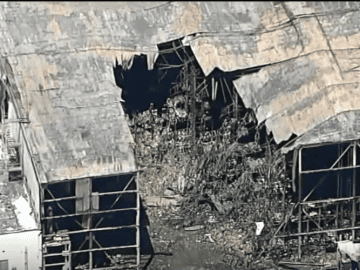
A volatile industrial chemical used in aerospace manufacturing overheated inside a Garden Grove facility, forcing mass evacuations and exposing deeper questions about industrial safety in crowded Southern California neighborhoods.
Thousands of residents across Garden Grove and surrounding Orange County communities were placed under evacuation orders after a dangerous industrial chemical inside a large storage tank began overheating at an aerospace manufacturing facility.
The chemical is methyl methacrylate, commonly known as MMA, a highly flammable industrial substance used to make acrylic plastics found in aerospace parts, aircraft windows, and other industrial products.
Officials warned the situation could lead to either a catastrophic explosion or a massive chemical spill after the tank became unstable, pressurized, and began venting toxic vapors into nearby neighborhoods.
The crisis is unfolding at a facility operated by GKN Aerospace on Western Avenue, inside one of the most densely populated parts of Orange County.
For many Southern California families, especially parents living near schools and residential neighborhoods, the emergency raised an alarming question: Why is a dangerous chemical tank located in the middle of a crowded city?
Methyl methacrylate is an industrial chemical widely used in manufacturing strong transparent plastics and aerospace materials.
It is commonly used for:
- Aircraft windows
- Aerospace components
- Industrial plastics
- Automotive products
- Construction materials
The chemical becomes especially dangerous when exposed to heat or uncontrolled chemical reactions.
According to emergency officials, the MMA inside the Garden Grove tank began overheating and entering what experts describe as a “thermal runaway” reaction. That means the chemical started generating its own heat faster than crews could safely control it.
As pressure built inside the tank, toxic vapors were released into the air.
Officials warned the tank was physically bulging and becoming increasingly unstable.
One of the biggest public questions has been why hazmat crews could not immediately drain or relocate the chemical.
The answer is far more complicated than many residents realize.
According to emergency officials:
- Internal valves broke while crews attempted shutdown procedures
- The chemical inside began thickening into a hot gel-like substance
- Pressure inside the tank continued rising
- The structure itself became unstable
That meant emergency crews could not safely approach the tank closely enough to pump the chemical into transport trucks.
Trying to manually force a transfer could trigger the exact explosion officials are trying to prevent.
For now, crews are focused on cooling and stabilizing the site rather than moving the material.
Why Is a Dangerous Chemical Facility in a Residential Area?
The answer reflects decades of Southern California growth patterns.
The GKN Aerospace site did not begin surrounded by dense housing.
Like many aerospace and industrial facilities across California, the plant was originally built during Southern California’s postwar aerospace expansion, when much of Orange County still included agricultural land and lower-density development.
Over time, Orange County’s population exploded.
Housing developments, apartment complexes, shopping centers, and schools expanded outward around older industrial corridors.
What was once a relatively isolated manufacturing area eventually became surrounded by neighborhoods.
Today, residential streets and schools sit directly near the facility.
That reality transformed what would once have been a contained industrial hazard into a public safety threat affecting tens of thousands of residents.
Orange County played a major role in the rise of America’s aerospace and defense industries during the Cold War era.
Factories throughout the region helped manufacture components for military aircraft and commercial aviation.
Facilities like the Garden Grove plant continued operating because they remained deeply connected to aerospace supply chains, including work tied to advanced aircraft manufacturing.
Those operations require chemicals like MMA to produce specialized transparent materials and aerospace plastics.
But many of those industrial zones now sit inside densely populated suburban communities.
The Garden Grove emergency is exposing the long-term consequences of that development pattern.
Latino and Working-Class Communities Often Live Closest to Industrial Risks
Across Southern California, industrial corridors frequently overlap with working-class neighborhoods where many Latino families live.
That can increase exposure to:
- Air pollution
- Chemical storage sites
- Warehouse traffic
- Industrial accidents
- Environmental health risks
For families already dealing with high housing costs, relocating away from industrial areas is often financially unrealistic.
The Garden Grove incident is now renewing broader questions about:
- Industrial zoning
- Environmental justice
- School proximity to hazardous sites
- Emergency preparedness
- Public notification systems
The Orange County Fire Authority has continued posting evacuation and reunification information through its public communication channels.
Residents should rely on official emergency guidance rather than viral social media claims.
The immediate priority is preventing a catastrophic tank failure.
Once the emergency is stabilized, the political and regulatory questions will likely intensify.
Residents and local officials may begin pushing for:
- Independent investigations
- Industrial safety reviews
- Hazard storage reforms
- New zoning discussions
- Emergency planning changes
Relocating facilities like this is expensive and legally complicated. But major industrial emergencies often trigger renewed public pressure and stricter oversight.
The larger issue now is whether rapidly growing Southern California communities are prepared for the industrial risks still operating inside densely populated neighborhoods.