Civil liberties advocates are raising concerns after multiple protesters arrested outside an ICE detention facility say FBI agents contacted them seeking information about fellow demonstrators.
John Mark Rozendaal was just trying to play music.
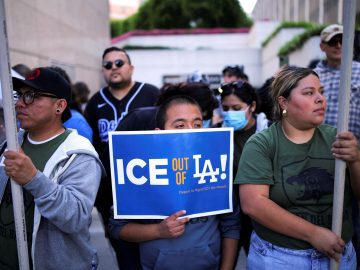
On May 29, along with scores from others, Rozendaal responded to calls on social media to gather outside of Delaney Hall, the immigration detention facility in Newark, New Jersey.
The privately run U.S. Immigration and Customs Enforcement facility had, in recent weeks, become the site of daily protests, spurred by a detainee hunger strike against alleged ghastly conditions within.
When Rozendaal went to Delaney Hall, he took his cello with him.
“I consider music to be a de-escalatory thing to do,” The Intercept told. “I sat down on the concrete barricade facing north and started to play.”
That night, however, the scene outside Delaney Hall quickly took a violent turn. New Jersey State Police and ICE agents issued a dispersal order and began to clear protesters from the area by force — with officers deploying chemical weapons and charging protesters on horseback.
“As I played, I saw this wall of plastic riot shields and cops in tactical gear advancing,” Rozendaal recalled. “Tear gas canisters were flying overhead. I could see horses behind the riot shields, flash-bangs. So it was quite dramatic.”
Moments later, Rozendaal was arrested by the New Jersey State Police and, according to an arrest report viewed by The Intercept, charged with one count of obstructing law enforcement. The charge was minor — but a week later, things took a strange turn when Rozendaal received a call from the FBI.
“The agent said, ‘We’re calling because you were arrested at Delaney Hall,’” Rozendaal told the website The Intercept. (The FBI declined to comment.)
In the following minutes, Rozendaal told the agents asked if he would be willing to provide the FBI with information on protesters that they described as “anybody planning to go to Delaney Hall with not the right intentions.”
“So, I mean, they were asking me to inform,” Rozendaal said.
Rozendaal is not the only Delaney Hall protester to receive a call from the FBI.
In the weeks since arrests began stacking up at the protests — approximately 90 people have been arrested so far — at least half of those taken into custody have received calls from federal agents looking for information, according to Benjamin Van Meter, a deputy public defender with the Essex County Public Defender’s Office who represents a number of protesters facing charges.
Van Meter lodged a complaint with authorities over the matter, claiming the FBI contact with his clients violated their constitutional rights.
The phone number used to contact Rozendaal, according to call history logs reviewed by The Intercept, is registered to the FBI’s New York field office and is posted online as an anonymous tipline.
Rozendaal said he rejected the offer immediately and, when the agent attempted to question him further, invoked his right to remain silent, ending the conversation.
The FBI has a long track record of trying to turn protesters, political dissidents, and ethnic and religious minorities into informants. The strategy, which is still commonly used today, can serve agents by both collecting information while stoking distrust among members of political movements and religious communities, according to Amol Sinha, executive director of the American Civil Liberties Union’s New Jersey chapter.