The Brooklyn Avenue Boyle Heights name change debate highlights tensions between honoring César Chávez, restoring historical identity, and recognizing Dolores Huerta’s legacy in East Los Angeles.
I heard it early in the morning, shortly after news broke about the sexual abuse allegations involving the late César Chávez.
“Now that streets, monuments, parks, schools, and other places may be renamed—removing César Chávez’s name—I hope they bring back the name Brooklyn Avenue to the street in Boyle Heights,” one resident told me.
For many, the name Brooklyn Avenue is deeply tied to childhood memories and growing up in East Los Angeles.
“Darlene Leyba—my niece—is named Brooklyn, and her great-grandmother lived near the church by White Memorial Hospital. Her house was torn down to expand the church area. It was sad. But I was so happy when my little cousin was named Brooklyn—it brings back so many memories,” said Linda Navarro, a Boyle Heights resident, in a Facebook group.
“The street named Brooklyn is where some of our parents and grandparents raised us. It’s where a family could always identify as home. It’s the heartline of businesses in Boyle Heights, much like Whittier Boulevard is to East L.A. or Sunset Boulevard is to other communities,” said Danny Alfaro. “Brooklyn defines this community, and when the name changed, it took away that identity for many of us.”
Brooklyn Avenue in Boyle Heights, Los Angeles, was renamed Avenida César Chávez in 1994—one year after Chávez’s death—to honor his legacy as founder of the United Farm Workers. The change marked an important moment in the community’s history.
The seven-mile stretch of road—still labeled Avenida César Chávez on some signs—had been known as Brooklyn Avenue for over a century before being renamed.
Now, many in the community are debating whether the street should return to its original name or be renamed after Dolores Huerta. Some oppose both ideas, preferring to restore the historical identity of their neighborhood and their parents’ generation.
“No matter what it’s called, it will always be Brooklyn Avenue to me,” said Hilda Vásquez.
Frank del Castillo provided historical context:
“In 1876, William H. Workman—the son-in-law of Andrew Boyle—subdivided the land for residential development. He and his partners chose the name Brooklyn Avenue to attract East Coast residents, especially from Brooklyn, New York, making the area feel like a home away from home.”
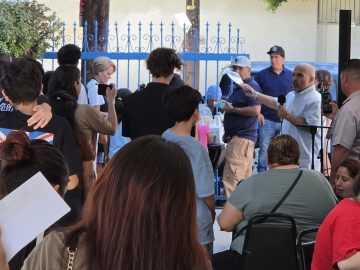
One day after the allegations against César Chávez became public, a wave of politicians and activists began circulating petitions to remove his name and image from public spaces. A mural honoring him was vandalized, his face crossed out in red, with calls for artists to replace it with another symbol.
“Gloria Molina made the name change happen. I would hope she would listen to our community about possibly changing it back to Brooklyn,” wrote Danny Alfaro.
“Someone correct me if I’m wrong, but I don’t think anyone in Boyle Heights had to vote or attend meetings about removing Brooklyn.
There are many cities across the U.S. and around the world where citizens have pushed to remove statues, signs, plaques, and street names because of what they represent.”
“I still call it ‘La Brooklyn,’” said Frank Villalpando.
Erasing Cesar Chavez? The Fight Over His Name—and the Fate of “Sí Se Puede”