
Rising consumer confidence and growing household debt reveal different sides of the economy. Here’s what the numbers mean for California families.
Americans are feeling more optimistic about the economy, but the latest household debt figures offer a more complicated picture.
Consumer confidence rose sharply in November. Earlier federal data showed that credit-card and home-equity balances also grew during the third quarter.
For California families facing high housing costs and other household expenses, the two reports highlight a distinction: confidence measures how people feel about the economy, not how much money they have left after paying their bills.
Consumer confidence rises as household debt grows
The Conference Board’s Consumer Confidence Index climbed 11.4 points to 103.3 in November, its highest reading since January 2025. The organization suggested that reduced uncertainty following the midterm elections may have contributed to the improvement.
Meanwhile, the Federal Reserve Bank of New York reported that outstanding household debt reached approximately $19.1 trillion in the third quarter of 2026.
Credit-card balances increased by $22 billion to nearly $1.29 trillion. Home-equity lines of credit, known as HELOCs, increased by $23 billion to $481 billion, the largest quarterly increase since 2005.
The overall debt increase of $334 billion requires context. About half of the $257 billion increase in mortgage balances reflected the return of previously unreported balances to credit records, rather than new borrowing.
The reports also cover different periods. The September debt figures cannot establish how households responded to November’s improvement in confidence.
Where financial pressures are concentrated
A November analysis by New York Fed researchers found that credit-card repayment difficulties increased particularly sharply in lower-income neighborhoods between 2022 and 2024. Neighborhood income is not necessarily the income of each borrower.
Recent national repayment figures offer a more encouraging signal. The annualized share of eligible credit-card balances newly becoming at least 90 days overdue declined from 7.05% in the third quarter of 2025 to 6.87% in the same period this year.
These figures do not establish a widespread household credit crisis. But they also do not eliminate concerns about unequal financial pressures in California.
LendingTree’s analysis of credit reports found that California borrowers in its sample carried an average credit-card balance of $9,421 in the first quarter of 2026, up 3.7% from a year earlier.
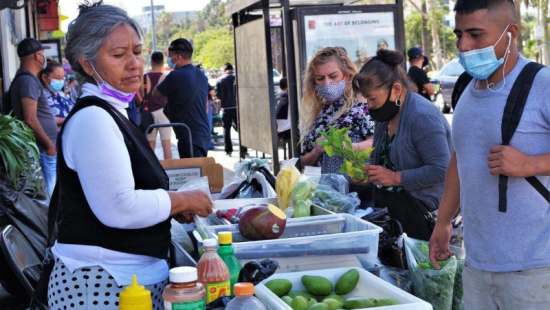
Higher debt payments can absorb income gains, leaving less money for essentials such as groceries in Los Angeles.
The California Legislative Analyst’s Office estimates that about 44% of California households have sufficient income to qualify for a mortgage on a lower-priced home, compared with 57% in 2019.
For existing homeowners, a HELOC allows them to borrow against accumulated home equity. It might finance improvements, education or unexpected expenses.
Borrowing for a planned renovation is different from repeatedly borrowing to pay utility bills. The national figures do not establish how much recent borrowing falls into either category.
How to assess your own financial security
A household budget can help you track several measures of financial progress:
- Does regular income cover essential monthly expenses?
- Are credit-card balances decreasing or growing?
- Can you pay more than the minimum amount due?
- Are you building emergency savings?
- Is borrowing covering planned purchases or recurring necessities?
The Consumer Financial Protection Bureau explains that HELOCs commonly carry adjustable interest rates and that payments may increase when the repayment period begins. Failure to repay can put your home at risk.
If you cannot afford your credit-card payments, contact your card issuer to discuss payment options or consider reputable nonprofit credit counseling.
November’s confidence rebound tells us that consumers feel better about the economy. Whether that optimism translates into improved financial security remains to be seen in subsequent income, spending and repayment data.