Yesterday, as he arrived at work, Manuel Vicente overheard several day laborers talking about their work a year ago during the fires that ravaged Los Angeles.
“Do you remember that a year ago we were out there helping with the fires, picking up trash, cleaning streets?” Vicente recalls them saying to one another. Today, few people talk about them, but they were a fundamental part of the assistance efforts in the affected areas of Palisades and Altadena.
These days, as the media marks and covers the first anniversary of this disaster, day laborers experience it the way they face every struggle: confident in their selfless help and ready to raise their hands and assist wherever they are needed.
“Immigrants, documented and undocumented, are essential for any disaster response. Neither Los Angeles nor the country can do it alone. Back then, just like during the pandemic, they were the first to step up and help. Authorities call them ‘essential,’ but afterward they are forgotten as people. It’s like saying, ‘I need your labor, but not you,’” says Vicente, General Director and co-founder of Radio Jornalera in the U.S. and other countries.
For him, Radio Jornalera has become the only information channel that truly represents workers. Being part of the National Day Laborer Organizing Network (NDLON) is a major advantage, as the building from which they broadcast is visited daily by hundreds of day laborers. They are close to them and understand the issues they face—the topics that truly matter to them.
“You find out that workers you know have been detained, and it fills you with anger and rage. That’s what keeps us going. The question we must ask ourselves in that moment is, ‘How do you respond to that anger?’ That’s when the fire—the fire of struggle—is ignited.” – Manuel Vicente
Despite the lack of recognition, Vicente refers to a Mexican saying: “Love is repaid with love.” Thanks to day laborers’ involvement in wildfire recovery efforts, a community network was built that has helped them face the challenges of 2025, especially immigration raids.
“The community knows it—they are the first to respond selflessly to catastrophes. After seeing the sacrifice they made, volunteer groups now help them by monitoring raids and providing support for other needs they face. That’s what’s valuable. As I’ve said, it hasn’t been politicians, leaders, or even organizations—it’s been the community,” Vicente says, repeating the mantra that has become a symbol of resistance: “Only the people save the people.”
The fires that destroyed Pacific Palisades and Altadena marked the beginning of a very difficult 2025. What followed was Donald Trump’s inauguration and the start of one of the largest immigration enforcement operations in recent history. Day laborers have been on the front lines, like cannon fodder, in the face of ICE presence.
“The other day, a day laborer came up to me and said, ‘Honestly, this is really hard and it’s scary. But you know what? Crossing the desert on foot, leaving your family behind, migrating—that’s not easy either. So we can endure this,’” Vicente recounts.
After the magnitude of the disaster became known a year ago, day laborers decided to organize themselves to work in the affected areas. They asked the community for help, and ten thousand people came forward. For the first time, they worked side by side with these workers.
After many exhausting days of labor, the day laborers’ work came under attack by the Trump administration.
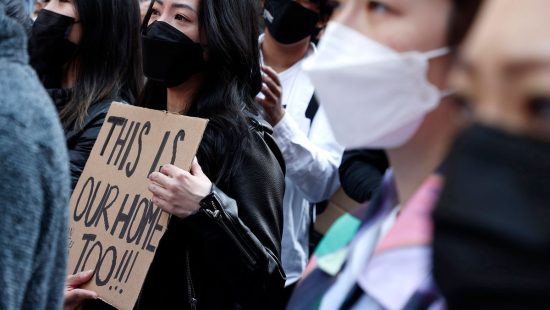
“And then, looking for work became an act of resistance. ICE started showing up at Home Depots, at the corners where they gather, to target them. Yet with the resilience they have, they are back in the same place the very next day. They are not intimidated. Every day, life goes on. We keep organizing, preparing plans for 2026. We don’t know what will happen, but they are committed to doing their work,” adds the director of Radio Jornalera.
Yesterday, they held a vigil in honor of the victims who died in the fires, and today they will tour the affected areas, showing solidarity through reconstruction efforts.
“We have a very clear vision of what needs to be done. We have several programs underway—‘Adopt a Home Depot,’ ‘Adopt a Car Wash’—all aimed at getting the community involved and protecting workers,” he adds.
For Manuel, who wakes up every day not knowing what lies ahead, there are moments when reality puts him to the test. “You find out that workers you know have been detained, and it fills you with anger and rage. That’s what keeps us going. The question we must ask ourselves in that moment is, ‘How do you respond to that anger?’ That’s when the fire—the fire of struggle—is ignited.”