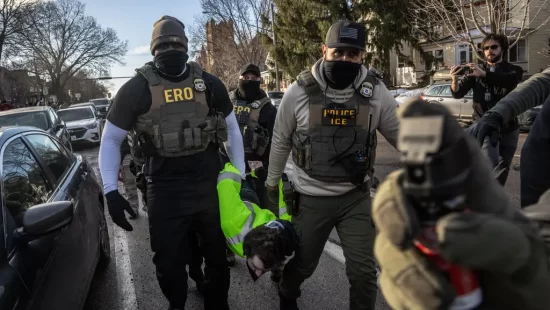
A Boston federal judge has issued a preliminary injunction preventing the Trump administration from ending the legal status of more than 8,400 migrants under family reunification parole programs, preserving their temporary legal status while the case proceeds.
A federal judge has once again put a stop to the Trump administration’s attempts to dismantle immigration programs created in recent years. Judge Indira Talwani of the Boston District Court issued a preliminary injunction blocking the termination of the legal status of more than 8,400 immigrants living in the country under family reunification parole, a measure announced by the Department of Homeland Security in late 2025.
The decision was issued on Saturday night and prevents the government from ending the humanitarian parole granted to relatives of U.S. citizens and permanent residents from Cuba, Haiti, Colombia, Ecuador, El Salvador, Guatemala, and Honduras. These individuals entered the United States legally through programs that allowed their relatives to sponsor them while they waited for an immigrant visa to become available.
The family reunification programs were created or expanded during the administration of former Democratic president Joe Biden with the aim of providing a legal and orderly pathway for migration, as well as reducing irregular border crossings. Under this scheme, U.S. Citizens and legal residents could request that certain close relatives live temporarily in the country, gaining access to work permits and stability while their immigration process moved forward.
However, on December 12, the Department of Homeland Security announced that it would end these programs. The Trump administration argued that they were incompatible with its immigration control priorities and had been misused to allow the entry of “poorly vetted” individuals. The plan was for the cancellation to take effect on January 14, 2026.
In response to this decision, migrant rights organizations filed a class action lawsuit, arguing that eliminating the program would expose thousands of families to deportation and disrupt legal processes that were already underway. As an initial response, Judge Talwani issued a temporary order freezing the measure for 14 days while she evaluated whether a broader block was appropriate.
That analysis has now resulted in a broader injunction, which has no set expiration date and will remain in place until there is a final decision in court or until a higher court lifts it. In her ruling, Talwani held that the Department of Homeland Security failed to adequately justify the policy change. In particular, she noted that the agency did not present evidence to support its allegations of fraud or assess the concrete consequences for the individuals affected, many of whom had already sold property, left jobs, or completely reorganized their lives in their home countries.
“The Secretary could not provide a reasoned explanation of the agency’s change in policy without acknowledging these interests,” the judge wrote in her ruling, referring to Homeland Security Secretary Kristi Noem. By failing to do so, Talwani added, the government’s action was “arbitrary and capricious,” a legal standard that allows courts to block administrative decisions.
The judge, who was appointed by former Democratic president Barack Obama, also noted that the government did not explain how these individuals could realistically return to their home countries after receiving official authorization to reside temporarily in the United States.
This is not the first clash between Talwani and the Trump administration. The judge had previously blocked the administration’s attempt to end humanitarian parole for some 430,000 people from Cuba, Haiti, Nicaragua, and Venezuela. That order was lifted by the Supreme Court and later overturned by an appeals court.
For now, the new court order offers respite to more than 8,000 people and their families by maintaining their legal status while the case continues in court.