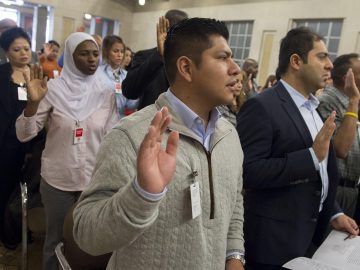
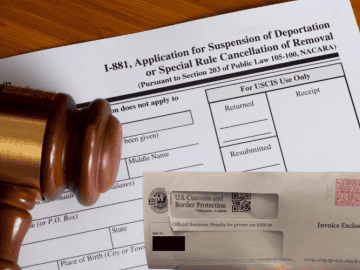
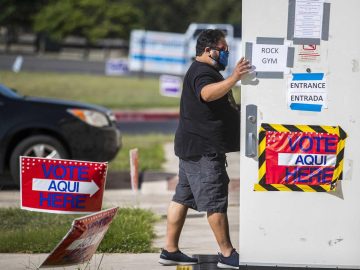
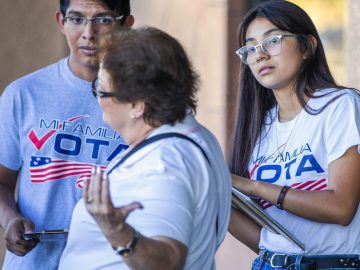
Concerns are rising across California over whether federal immigration agents could appear near voting locations during the November midterm elections. Latino communities in Los Angeles and Southern California say the issue could affect turnout and trust in the voting process.
In California, concerns are growing over what role, if any, federal authorities could play in the upcoming November midterm elections.
Despite unfavorable national polling, President Donald Trump has shown little concern about low approval ratings. Instead, attention in the state has shifted toward speculation that federal immigration agents could appear at or near polling places, raising fears about potential voter intimidation.
California officials point to clear legal protections. State law restricts law enforcement activity around voting sites, while federal law prohibits the deployment of armed personnel to polling locations. The key question is whether those boundaries would be tested.
Throughout his second term, Trump has shown a willingness to challenge legal limits, prompting ongoing debate among California policymakers and advocates about how to safeguard elections from potential interference.
State Law and Local Concerns
State law prohibits voter intimidation, and federal law bars the presence of troops or armed personnel at polling locations. Still, across Southern California, some voters remain uneasy about the possibility of encountering U.S. Immigration and Customs Enforcement agents near voting sites.
“Yes, by definition, if you’re showing up to vote, you’re an American citizen. But given how enforcement actions have been carried out, it’s not unreasonable for Latinos to worry about being caught up in immigration sweeps, even if they are here legally,” said Christian Arana of the Latino Community Foundation.
A September poll commissioned by the organization found that 66 percent of 1,200 registered Latino voters surveyed in California were concerned about immigration enforcement at polling places during the 2025 special statewide election. Concern was highest in Los Angeles County at 68 percent, followed by 70 percent in the San Diego and Orange County region, and 57 percent in the Inland Empire.
Earlier this year, Trump ally Steve Bannon suggested deploying ICE agents and military personnel to polling locations. When asked about those remarks on May 1, the Trump administration pointed to prior comments from White House press secretary Karoline Leavitt, who said she was unaware of any formal plan but could not guarantee that immigration agents would not be present near voting sites.
The Department of Homeland Security has said any presence by its officers would be tied to specific threats, not intimidation.
What California Law Says
The California Secretary of State’s office emphasizes that state law limits law enforcement activity at or near polling locations, while federal law prohibits armed personnel from being deployed to such sites. Federal statutes also ban intimidation, threats, or force in connection with elections.
State officials have also created systems for counties to quickly report voter intimidation or disruptions.
“It is a felony to use force, violence, coercion, or intimidation to compel someone to vote or not vote,” according to guidance shared with local election officials.
Prohibited behavior includes blocking access to polling sites, threatening legal consequences, questioning voters aggressively based on race or gender identity, asking about citizenship, requiring specific identification beyond legal requirements, or displaying weapons.
Election offices in Los Angeles, Orange, and Riverside counties say they have protocols in place to ensure safe, intimidation free voting environments.
“Our election workers are trained to identify anything that could interfere with voting,” said Mike Sanchez of the Los Angeles County registrar’s office. “If an issue arises, it is escalated immediately to determine the appropriate response.”