From Los Angeles to rural communities, a growing number of children say they want to become YouTubers or influencers, raising new questions about how social media is reshaping career ambitions and what schools can do to prepare students for reality.
In recent large U.S. surveys, around 1 in 3 kids (about 30%+) say they want to be a YouTuber or content creator when they grow up.
Influencer or YouTuber-type careers often rank at or near the top of kids’ dream jobs, alongside athlete or teacher.
This trend is strongly driven by exposure to platforms like YouTube and TikTok, which are especially popular in places like California, where many creators also live and work.
So for California specifically, the most accurate way to put it is:
“A large share of kids in California, similar to the rest of the U.S., say they want to be YouTubers or influencers, and it is one of the most popular dream careers.”
Since 2021, teachers have spoken with a range of elementary, middle, and high school students as young as 7 years old in the U.S. and Norway in 2024 to understand how children imagine their careers.
The upcoming research shows that social media has emerged as one of the biggest influences on young people’s career choices, second only to family, friends, or teachers.
Over 60% of middle and high school students we surveyed from 2021 to 2024 said they wanted to be social media influencers or chose their future careers based on what they saw online. Other popular choices included professional soccer player, musician, and actor.
Studies done in Mexico and across Latin America find that a YouTuber or influencer is consistently among the top dream jobs for kids.
In some surveys, around 10% to 30% of kids choose YouTuber or influencer as a desired career, depending on how the question is asked and the country.
It often ranks behind traditional jobs like doctor, athlete, or teacher, but still very high compared to past generations.
Our process
In a separate January 2018 international study by the organization Education and Employers, 20,000 children ages 7 to 11 were asked about their possible future careers and how they learned about those jobs.
We found a disconnect between how schools help kids think about careers and the factors that actually influence how young people imagine their futures.
Influencer dreams
In some instances, students as young as 7 simply drew the YouTube or TikTok logo or wrote that they aspired to be an “influencer” without a clear idea of who or what they would influence.
They shared that YouTubers and influencers “get lots of money” and that they “want to be famous.”
Students also drew pictures of footballers, musicians, actors, and princesses. Some students mentioned goals such as becoming a wildlife biologist, pilot, engineer, or filmmaker.
Older students were more likely to mention careers like nurse, electrician, engineer, teacher, welder, police officer, and small-business owner. However, becoming an influencer and content creator remained a common aspiration among teenagers and children.
We also found that social media had a positive influence on some students.
One student in a rural town said that online posts and videos encouraged them to want to become a marine biologist, even though the closest ocean is over 1,300 miles, or about 2.09 million meters, away.
The limited role of schools
It is common for middle and high school students to take online career interest surveys to help understand which jobs could be a good fit. Many schools also offer career fairs and job shadowing opportunities.
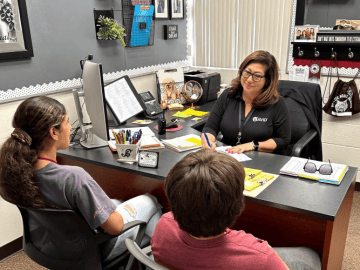
Most students, though, receive very limited individualized guidance on career paths from a school counselor, although they generally do receive some kind of prompts to help them think about their future careers.
Within roughly the past decade, 27 states began requiring personalized, multiyear educational plans that help students as young as 11 develop their own education and career goals.
In 2015, for example, Wisconsin passed a law requiring school districts to provide academic and career planning services to students in grades 6 through 12. Students take an online career survey each year.
Students answer questions about their interests, and the online program then suggests a recommended career. The list typically includes traditional jobs like electrician or accountant, rather than more modern roles like content creator.
One potential reason is that many online career-planning programs used by schools were created before social media became a central part of young people’s daily lives.
When dreams don’t match reality
Many young people now learn about careers through TikTok videos, YouTube channels, social media personalities, and online communities. These influences can play a larger role in shaping career aspirations than formal school career-planning activities.
While many people aspire to make money online as influencers or content creators, nearly half of all online content creators earn less than US$15,000 a year.