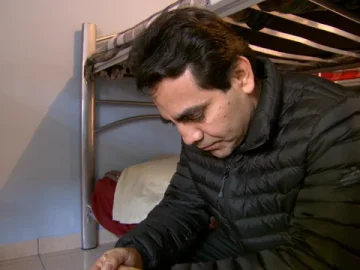
Erick Flores, a 56-year-old Mexican man who spent the last two decades working as a chef in New York City, prepared a salad for Donald Trump before he became president.
Thousands of Mexicans deported from the United States are rebuilding their lives in a Mexico City neighborhood known as “Little L.A.” The community has become a cultural and emotional refuge for people who spent much of their lives in California and other parts of the U.S.
“I was born in Mexico, but I spent most of my life growing up in the United States. Now that I’ve been deported back, I feel like I belong neither here nor there.”
Iván Porras, a 33-year-old Mexican photographer and musician, lived two-thirds of his life in Nevada and California. He arrived there as a child and remained there until his expulsion last year.
This sense of not fully belonging to either country is shared by tens of thousands of undocumented individuals who are returning—whether voluntarily or, in the vast majority of cases, forcibly after being detained under the aggressive immigration policies of Donald Trump’s administration—to a Mexico they barely remember.
However, many of them have found a small haven in the heart of the Mexican capital—a place that, in a way, blends cultural elements from both nations and helps them feel more understood by connecting with a large community that has gone through a similar experience.
It is called Little L.A. (“Little Los Angeles”), and it is located in Mexico City’s Colonia Tabacalera—a neighborhood that reminds some residents of the Californian city due to its abundance of palm trees.
In recent years, a large number of Mexicans deported from that U.S. state have gravitated to this area, drawn by the presence of several call centers where their fluency in both English and Spanish makes them strong candidates for jobs as telephone operators.
Today, it is a common sight to find many of them gathering in Little L.A. after their shifts, speaking Spanglish and comfortably code-switching between languages in bars that advertise “snacks & beers” in English and feature menus offering typical dishes from both countries. “In this neighborhood—Little L.A.—I’ve met many deportees who have already been here in Mexico for quite some time. We share the same experience, the same struggles, and we can communicate in English. That helps a lot, because you no longer feel alone or isolated from the rest of the country,” notes Porras.
The epicenter of this little Mexican Los Angeles is the iconic Monument to the Revolution—a structure originally commissioned with the intention of becoming the country’s Legislative Palace.
“For us, [the monument] is significant because it was conceived to be something entirely different. It is crucial to remember that sometimes we begin our stories in other places—much like many of our repatriated brethren—but that doesn’t signify an end; rather, it marks the beginning of something new,” Shunaxy Estrada, Director of Volunteers in Mexico for New Comienzos, tells BBC Mundo.
This organization—which assists migrants returning to Mexico with legal aid, psychological support, job placement services, and other forms of assistance—has played a pivotal role in the rise of Little L.A.
“By providing a place where they can connect and feel a sense of belonging, we are, in our own way, taking them by the hand and letting them know that they are not alone,” she affirms.