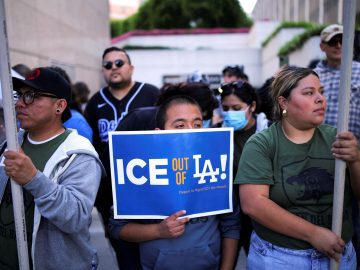
ICE enforcement is reaching deeper into Latino communities even as the nation’s Latino population approaches 70 million and becomes increasingly U.S. born.
For Latino families across the country, immigration enforcement is no longer only a story about the border.
ICE arrests are increasingly happening in neighborhoods, at workplaces, during immigration check-ins and in other places where people live their everyday lives. In Los Angeles, immigration arrests more than tripled during the first year of President Donald Trump’s second administration, according to a UCLA report.
And the enforcement campaign is still expanding.
ICE arrested 49,571 people in July 2026, the highest monthly total of Trump’s second term and a 15% increase from June, according to data analyzed by the Deportation Data Project. More than half of those arrested had no criminal convictions or pending charges.
At the same time, something else is happening that is easy to miss:
The Latino population keeps getting bigger.
The U.S. Census Bureau estimates that 70.1 million Hispanics lived in the United States as of July 2025, representing 21% of the nation’s population.
Those two realities are now colliding inside America’s communities.
The scale of today’s enforcement is different from simply increasing patrols at the southern border.
Researchers at the Deportation Data Project found that deportations from inside the United States increased fivefold during the first year of the second Trump administration. ICE street arrests increased even more dramatically, rising about elevenfold. Those arrests include people taken into custody in neighborhoods, immigration courts and ICE offices during regular check-ins.
For Latino communities, that can have consequences far beyond the person who is arrested.
Families can lose income. Children can lose a parent. Workers may stop going to work. Small businesses can lose customers.
A UCLA analysis of the 2025 enforcement surge in Los Angeles County found that business corridors near nine enforcement sites experienced about 46,000 fewer visits and an estimated $3.16 million in accumulated losses in just two weeks. Latino business owners reported economic and psychological effects that continued nearly a year later.
Another UCLA analysis found that enrollment in a Medi-Cal expansion program for adults fell by nearly 71,000 during the second half of 2025, a period of intensified immigration enforcement. Researchers said the findings suggest fear of immigration enforcement may have influenced some people’s decisions about enrolling in or maintaining coverage.
That is what enforcement looks like when it reaches a community.
It does not stop at the person being detained.
But the Latino population is increasingly made up of Americans born here
This is the part of the immigration debate that can get lost.
The Latino population is not simply a measure of how many immigrants are arriving at the border.
Pew Research Center found that the Latino population nearly doubled from 35.3 million in 2000 to 68 million in 2024. Latinos accounted for 56% of total U.S. population growth during those 24 years.
And most Latinos are U.S.-born.
About 67% of U.S. Latinos were citizens by birth in 2023, according to Pew.
That distinction matters.
An immigration crackdown can reduce the number of people entering the country. It can remove immigrants who are already here. But it cannot erase the millions of U.S.-born Latinos who are already part of America’s population.
That demographic reality is also why the question of birthright citizenship matters beyond the immigration debate itself. Parriva previously explained what the Supreme Court’s ruling means for American-born children and immigrant families in its guide to the birthright citizenship decision.
The bigger picture is becoming harder to ignore:
America’s Latino population is increasingly being shaped by generations born in the United States.
The border can change. The demographic reality is harder to change.
That does not mean immigration policy has no effect on Latino population growth.
It does.
Pew found that unusually large numbers of immigrants arriving in 2023 and 2024 contributed to annual Latino population increases of nearly 2 million — the largest yearly increases on record.
But the Latino population has also been growing through births and through generations already living in the United States.
That means today’s enforcement campaign can change the pace and composition of future growth without reversing the demographic transformation that has already happened.
And the transformation is increasingly important to the country’s economic future.
Parriva has previously examined why Latino population growth could become increasingly important to the U.S. economy through 2030.
That question is becoming even more relevant now.
The demographic challenge extends beyond the Latino population.
The Congressional Budget Office projects that the U.S. population will age significantly over the coming decades. Beginning in 2030, deaths are projected to exceed births, meaning net immigration will account for all U.S. population growth in CBO’s projection. Without immigration, the population would begin shrinking in 2030.
At the same time, CBO has already lowered its population and immigration projections because of administrative actions taken since 2025 and changes in immigration policy. The agency projects net immigration of about 570,000 people in 2026, far below the 2 million it had projected in an earlier forecast.
That creates a complicated future.
America is becoming older.
Immigration is slowing.
And the Latino population — one of the country’s youngest major demographic groups — continues to grow.
So the consequences of immigration policy aren’t limited to immigration itself.
They reach into the workforce, neighborhoods, schools, businesses and the country’s long-term population.
What this means for America’s future
The central question is no longer simply how many people will cross the southern border.
It is what happens when a country dramatically expands immigration enforcement while the demographic group most closely associated with the immigration debate is increasingly U.S.-born, deeply established and essential to America’s future.
For a Latino family, that future can feel very immediate.
It can mean worrying about an ICE operation in the neighborhood.
It can mean a worker staying home because they are afraid of being stopped.
It can mean a small business losing customers after a raid.
It can mean children growing up in a household where one family member is a citizen and another lives with immigration uncertainty.
And it can mean something much larger for the country:
The United States cannot separate its immigration story from its Latino demographic story anymore.
The border will continue to rise and fall as administrations change.
Enforcement policies will change too.
But the 70 million-plus Latinos already living in America — most of them U.S.-born — are not going anywhere.
They are the workers, parents, students, entrepreneurs and voters who will increasingly shape what America looks like long after today’s immigration policies have changed.